
How to Build a Brand in Dubai: A Strategy-First Guide From Idea to Everyday Experience
Dubai rewards people who move quickly. A trade licence can arrive before the logo does, a shopfront can open before anyone has agreed what the business stands for, and a social account can go live before the first customer conversation. Speed is not the problem. The problem is building the visible parts of a brand on a foundation nobody has poured.
This guide is for founders, marketing leads and family businesses who want to know how to build a brand in Dubai in the right order. It is not a list of design trends. It is a working sequence: the decisions to make first, the questions to answer honestly, and the moments where a brand strategy in Dubai either becomes real or quietly stays on a slide.
Start with the uncomfortable question: why should anyone choose you?
Every market in the UAE has familiar categories and crowded shelves. Restaurants, clinics, real estate brokers, consultancies and online stores often describe themselves with the same words: premium, trusted, innovative, customer-focused. Those words are not wrong, but they rarely help a customer decide.
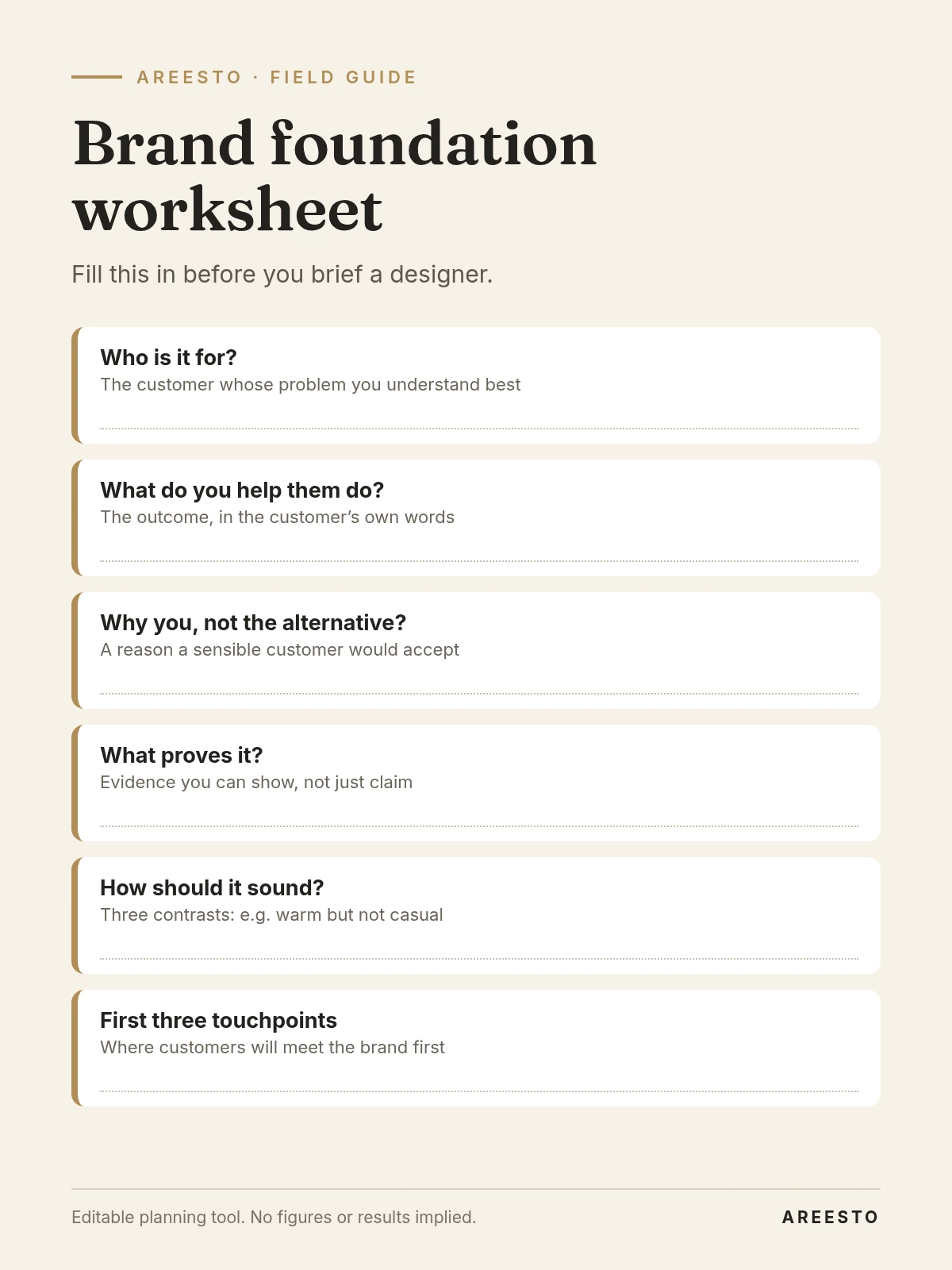
Before you brief a designer, write one paragraph that answers three things:
- Who you are for. Not “everyone in Dubai”, but the people whose problem you understand best.
- What you help them do. The practical outcome, described in the customer’s language.
- Why you, specifically. The reason a sensible customer would pick you over a credible alternative.
If that paragraph is hard to write, that is useful information. It means the brand needs strategic work before it needs a colour palette. Our guide to brand strategy, identity and positioning explains why these layers are different and which one usually comes first.
Step 1: Understand the people you want to serve
Dubai is not one audience. Residents, visitors, business buyers and families may share a postcode and still make decisions in completely different ways. Language preference, price expectations, preferred channels and the role of recommendations can vary between groups, so assumptions copied from another city or another category can mislead you.
You do not need a large study to begin. You need evidence that is better than your own opinion. A practical starting point is a handful of structured conversations with real or likely customers, a careful look at the questions they already ask your team, and a review of how competitors explain themselves. If you are choosing between interviews, surveys and desk research, our guide to choosing the right study before entering the UAE walks through the trade-offs.
Listen for the words customers use, the worries they mention before buying and the moments they describe as frustrating. Those phrases often become the raw material for messaging later.
Step 2: Map the alternatives honestly
A competitor list is not the same as a competitive map. Customers compare you with direct rivals, with indirect substitutes and with the option of doing nothing at all. A boutique gym competes with other gyms, but also with running clubs, home equipment and the customer’s own busy calendar.
For each alternative, note what it promises, how it looks and sounds, where it is visible and what it seems to leave unanswered. The gaps matter more than the strengths. A space nobody is speaking to clearly can become your starting point, provided it reflects something you can actually deliver.
Step 3: Choose a position you can keep
Positioning is a decision about what you want to be known for, and what you are willing not to be known for. That second part is where many brands hesitate. Trying to be the cheapest, the most premium and the most innovative at once usually produces a message that is easy to ignore.
A useful positioning statement is specific enough to guide choices. It should help you decide which customers to prioritise, which services to lead with and which opportunities to decline. If you want a deeper look at how this works for local businesses, see our brand positioning services in Dubai.
Test your position against reality. Can your operations support it on a busy Thursday evening? Can your team explain it without a script? Can you show proof rather than simply claiming it? A position that cannot survive daily operations is a slogan, not a strategy.

Step 4: Give the brand a voice and a story
Once the position is clear, decide how the brand should sound. A family law practice and a streetwear label might both want to sound confident, but confidence will feel very different in each. Describe the voice with a few contrasts: warm but not casual, expert but not academic, bold but not loud.
Then shape a core story. It does not need to be dramatic. It needs to explain the problem you noticed, the way you approach it and why that approach matters to the customer. Keep it true. Customers in a city full of polished marketing are quick to notice when a story sounds borrowed.
In the UAE, also decide early how the brand will work in Arabic and English. That affects the name, tagline, tone and even the layout of future materials. A message that sparkles in one language can feel flat or awkward in the other, so plan for both rather than translating at the last minute. Our article on Arabic and English brand identity sign-off tests offers a practical checklist.
Step 5: Name it carefully
A name carries a heavy load: it has to be memorable, workable in both languages, available for registration and suitable for the market you are entering. Trade-name rules and trademark availability need to be checked with the relevant authorities and qualified advisers before you fall in love with an idea.
Shortlist names against your positioning, not only against your taste. Say them out loud, imagine them on a storefront and in a WhatsApp message, and check how they look in Arabic script. Our brand naming service in Dubai and the guide on how to name a business in Dubai go deeper into this step.
Step 6: Design the identity as a system, not a logo
The logo is the most visible part of a brand and often the least important on its own. What customers actually experience is a system: colour, typography, imagery, layout, iconography, photography style, motion and the way all of these behave on a menu, a website, a uniform or a delivery bag.
Ask your design partner to show the identity in use, not only on presentation boards. How does it look on a small phone screen? On a dark storefront sign? In a bilingual brochure? In a social post that has to be produced quickly by someone who was not in the original workshop?
Before you approve, write a short brief that explains the strategy and what you need the identity to do. The guide on writing a branding agency brief in Dubai can help you get comparable proposals and a clearer process.
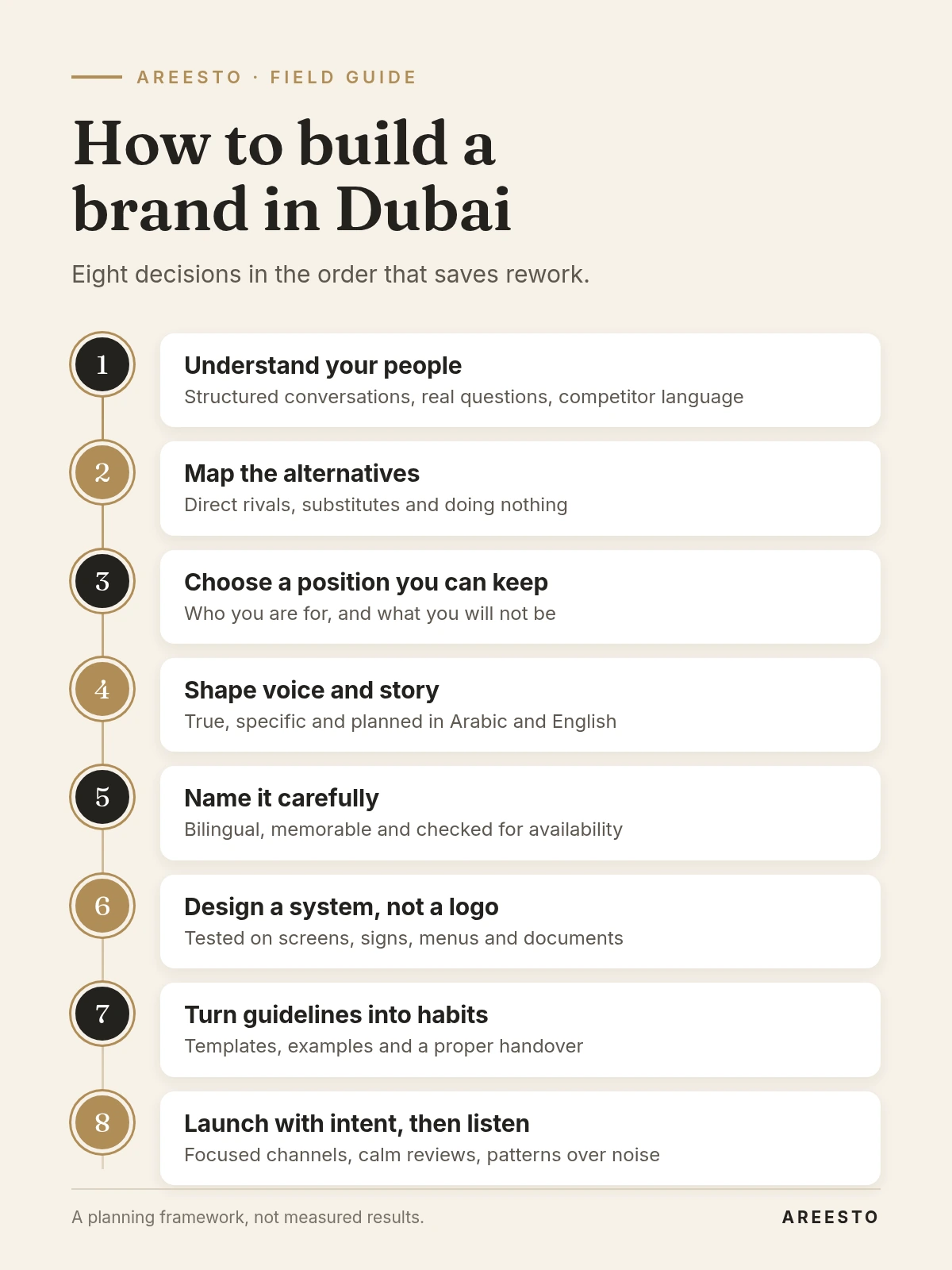
Step 7: Turn guidelines into daily habits
A brand book that lives in a shared drive is not a brand. A brand becomes real when the receptionist, the sales executive, the social media freelancer and the delivery partner all make consistent choices without asking for permission each time.
Keep the guidelines practical. Include examples of correct and incorrect use, ready templates, tone-of-voice examples and the answers to common questions. Then hand them over properly. Our article Your brand book is finished. Can your team actually use it? explains what a useful handover looks like.
Step 8: Launch with intent, then listen
A launch is a moment to introduce the brand clearly, not a guarantee of attention. Decide which customers should notice first, which channels they actually use and what you want them to do next. A focused launch on a few channels, executed well, is often more useful than a thin presence everywhere.
After launch, review what customers say, where they hesitate and which messages lead to real conversations. Do not treat early reactions as final verdicts, and do not change everything after the first week. Instead, look for patterns. If you are renaming or refreshing an existing business, our rebranding launch and migration checklist will help you protect the customers you already have.
Common mistakes when building a brand in Dubai
- Starting with the logo. Visual decisions made before strategy often need to be reworked later.
- Copying a successful competitor. Borrowed positioning makes you the second choice by design.
- Treating Arabic as an afterthought. Bilingual expression needs to be planned from the start.
- Promising what operations cannot deliver. The fastest way to weaken a brand is a broken promise.
- Measuring only likes. Look for evidence of understanding, preference and real enquiries, not just reach.
- Never reviewing. Markets, customers and your own business change. Plan regular, calm reviews rather than sudden overhauls.
How long does it take to build a brand?
There is no honest universal timeline. The pace depends on how much research you need, how many decision-makers are involved, whether naming is included, how many languages and touchpoints are in scope and how quickly feedback arrives. What we can say is that rushing the early decisions usually costs more time later. If you are comparing quotes, the article on why branding quotes in Dubai differ explains how scope shapes both time and budget.
Where professional support helps
You can do a lot of this work yourself, especially in the early stages. External support becomes valuable when the decisions are contested inside the business, when the stakes of a wrong name or position are high, or when you need the identity to perform across many touchpoints and two languages.
At Areesto we approach this as a connected process: research and brand strategy in Dubai first, then naming, identity and rollout through our wider branding services for UAE businesses. If you would rather check where your current brand stands before building anything new, start with a brand audit across your customer touchpoints.
Frequently asked questions
What is the first step to building a brand in Dubai?
Start by defining who you serve, what you help them achieve and why they should choose you over credible alternatives. Research and positioning should come before naming and design.
Is brand strategy different from marketing?
Yes. Brand strategy defines what the business stands for and how it should be perceived. Marketing uses that foundation to reach people through campaigns, channels and offers. Marketing without strategy tends to change direction every season.
Do I need my brand in both Arabic and English?
That depends on your customers and the touchpoints you need. Many UAE businesses benefit from planning both languages early, because the name, tone and layout can behave differently in each.
Can a small business build a strong brand without a big budget?
Yes, if it focuses on clear positioning and consistent everyday experience before expensive production. Our guide on why branding matters for small businesses in Dubai covers this in more detail.