
Before You Hire a Branding Agency in Dubai: Write a Brief That Gets Comparable Proposals

Imagine proposals arriving looking equally polished. One promises a complete brand, another offers an identity package, and a third lists enough deliverables to fill a page. Yet none quite describes the same job. You are not comparing agencies anymore. You are comparing interpretations of a conversation.
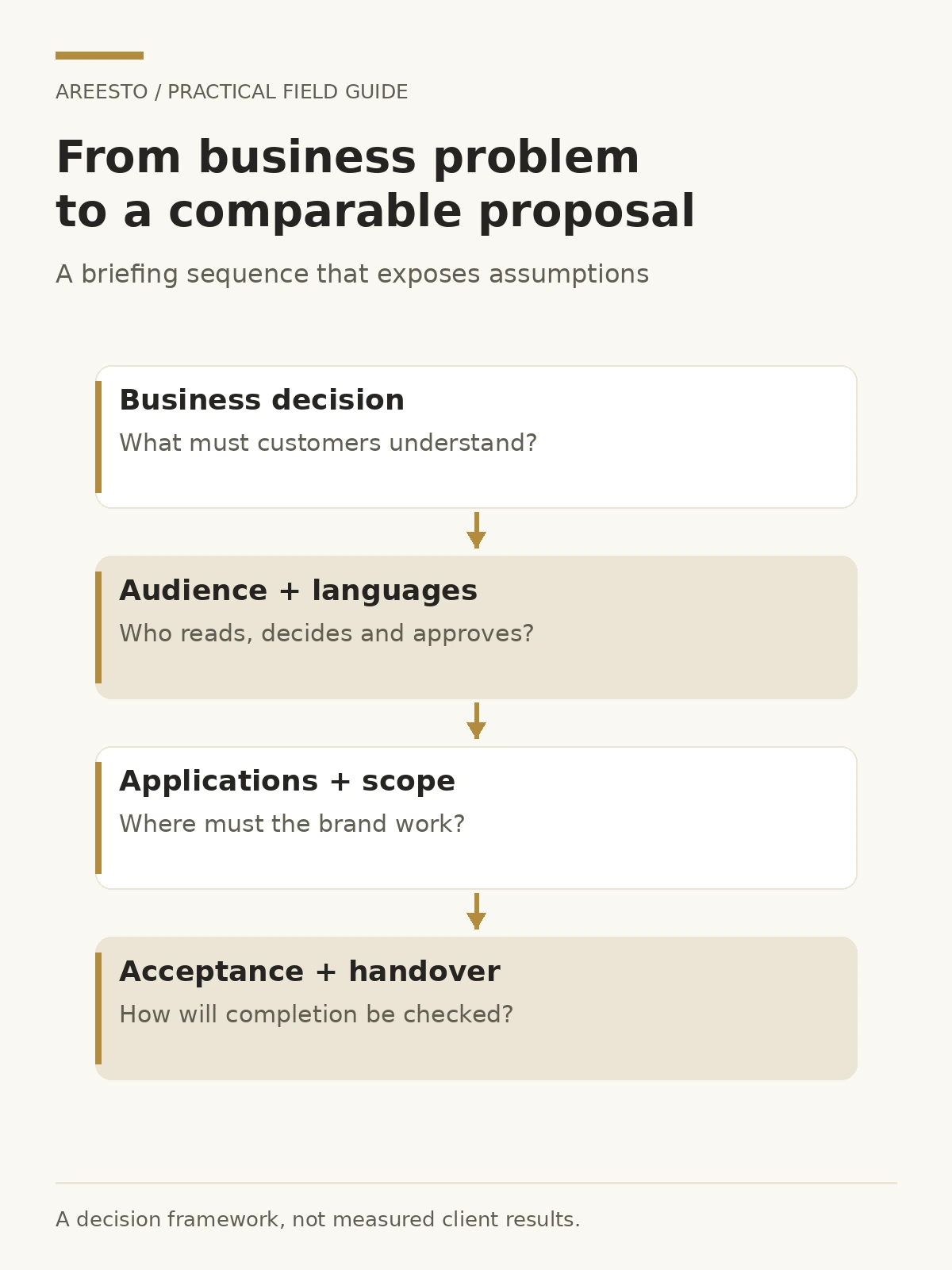
A useful branding brief prevents that confusion. Before hiring a branding agency in Dubai, define the business problem, the audiences and languages, the required applications, the approval process and the handover. Give every shortlisted agency the same starting information. You can then compare how they think, what they include and where their responsibilities end.
Define the decision the brand needs to support
A request for a modern logo describes an output, not a business brief. It does not explain whether the company is entering a market, moving upmarket, combining several offers or struggling to communicate an established service. Without that context, an agency can produce attractive work that solves the wrong problem.
Describe the situation in plain language. What changed in the business? Who needs to understand you differently? Where does the current brand create friction? Separate evidence from opinion: recurring customer questions, lost-sale feedback and inconsistent presentations are useful inputs; a leadership preference for a colour is a preference, not proof.
Write a decision statement
Use this working sentence: “We need the brand to help [audience] understand [offer or difference] so they can confidently [next decision].” It is a briefing tool, not a promise of commercial results. A distributor, a procurement manager and a walk-in customer may require different information even when they buy from the same company.
Also record what should not change. A recognised name, a useful product hierarchy or a familiar symbol may deserve protection. Ask the agency to challenge these assumptions with reasons rather than silently treating everything as either untouchable or disposable.
Specify the scope in applications, not impressive labels
“Full branding” means little until you describe where the work must function. List the applications your team genuinely needs: a bilingual proposal, storefront signage, a product label, a mobile landing page, a presentation template or a vehicle graphic. Distinguish launch essentials from later work. This makes both the quote and the eventual handover more realistic.
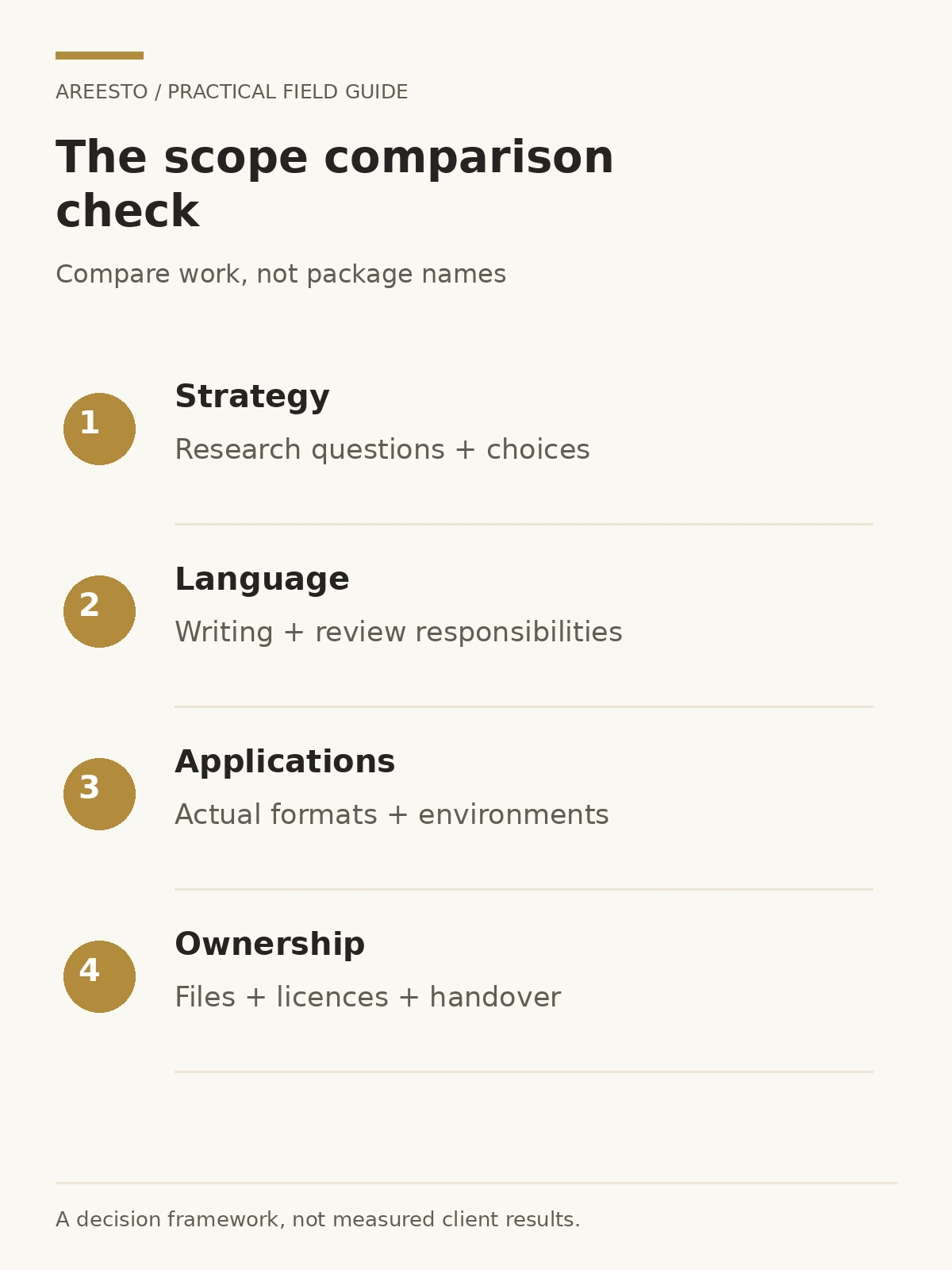
Separate strategy, verbal identity, visual identity and rollout. An agency might include positioning but exclude customer interviews; provide a logo suite but not a presentation master; design packaging but not supply structural engineering or print production. None of those exclusions is automatically wrong. Hidden assumptions are the problem.

For Arabic and English work, describe what “bilingual” covers. Does the agency develop messages in both languages, adapt approved text or arrange translation? Who checks meaning and industry terminology? Which wordmarks, lockups, layouts and templates need both scripts? Avoid leaving language requirements as a small note after the deliverables list.
Digital applications need more than visually mirrored mockups. The W3C’s guidance on right-to-left text explains that document direction and language are separate concerns. Your brief need not prescribe code, but it should require the relevant Arabic layouts and forms to be tested in their actual environment.
Use a scope worksheet
| Workstream | Decision to record | Acceptance evidence |
|---|---|---|
| Research and strategy | Which audience questions require investigation? | Agreed findings, choices and positioning rationale |
| Naming and messaging | Which names and text fields are included, in which languages? | Approved copy record and clearly defined checking responsibilities |
| Visual identity | Which formats and real applications must work? | Legible application tests and agreed logo variants |
| Templates and rollout | Which tools will staff edit and who will deploy them? | Working native files, instructions and named owners |
Agree how decisions will be made
A project can stall even when the work is good. One stakeholder approves a direction, another reopens the positioning, and the team discovers that nobody had final authority. Prevent that situation before design begins.
Name a project owner who collects feedback and a final approver who can resolve conflicts. Involve the people who will use the assets: sales, operations, digital and any production supplier whose requirements could change the design. Not everyone needs to approve every detail, but relevant constraints should arrive before the final export.
Agree stages such as discovery, strategic direction, creative direction, development and handover. For each stage, define what is being decided and what evidence is needed. Ask agencies to explain what counts as a revision within an approved direction and what would be a new scope request. This is a discussion about boundaries, not a hunt for a universally correct revision count.
Keep a decision log. Record the choice, the reason, the approver and any unresolved dependency. Feedback such as “make it premium” is difficult to act on; feedback such as “the descriptor becomes unreadable on the small label we agreed to test” gives the designer a problem to solve.
Define ownership and handover before signing
Receiving a PDF does not necessarily mean receiving an editable system. Ask what native files, export formats, templates and instructions are included. Specify the software your team actually uses. A beautiful template that requires an unfamiliar tool or an unavailable font is not an operational handover.
Clarify intellectual-property terms in the contract: what rights are transferred, when they transfer, and which third-party elements remain subject to separate licences. Fonts, stock imagery and software subscriptions may have their own conditions. Do not assume an agency can transfer rights it does not own; have the relevant contract terms reviewed where necessary.
Agree whether printing, signage installation, domain work, photography and developer implementation are included or separately commissioned. For naming, distinguish creative screening from specialist legal clearance. The brief should identify who obtains any required professional advice or approvals without claiming that design approval provides them.
Compare the responses using the same questions
Read proposals against the brief rather than against each other’s marketing language. Can the agency explain the business problem accurately? Does its approach address your uncertainty? Are language responsibilities and applications explicit? Does the schedule depend on decisions your team can realistically make?
Ask each agency to identify assumptions, exclusions, client inputs and handover contents. Where proposals differ, request clarification rather than inventing an equivalent price for missing work. Evaluate relevant work by the reasoning and execution shown, not by unsupported promises that your project will produce the same result.
If you need help defining the scope, explore Areesto’s branding services for UAE businesses. Bring your current materials, the applications you need and the decisions that remain unclear. That is a more productive starting point than asking for “a complete brand” with no shared definition.
Frequently asked questions
How detailed should a branding brief be?
Detailed enough to explain the business problem, audience, required applications, languages, constraints and approval process. It should guide the agency’s thinking without prescribing every creative answer.
Should I disclose my budget?
A realistic range or a clear spending constraint helps agencies propose an achievable scope. Ask them to distinguish essential work from optional phases rather than hiding exclusions inside an attractive headline.
Should Arabic be added after the English identity is approved?
If both languages are needed, include them in the original scope. Plan how meaning, typography and applications will be reviewed together rather than treating Arabic as a late formatting task.
Does the brief replace a contract?
No. It describes the intended work. The contract should establish the agreed deliverables, responsibilities, commercial terms and rights, with appropriate professional review where needed.