
Interviews, Surveys or Desk Research? Choose the Right Study Before Entering the UAE

Imagine a planning meeting beginning with a broad request for research on the UAE market. Soon the wish list includes market size, customer motivations, competitor prices, product feedback and a launch forecast. Everyone agrees that evidence would help. Nobody has yet said which decision the evidence must support.
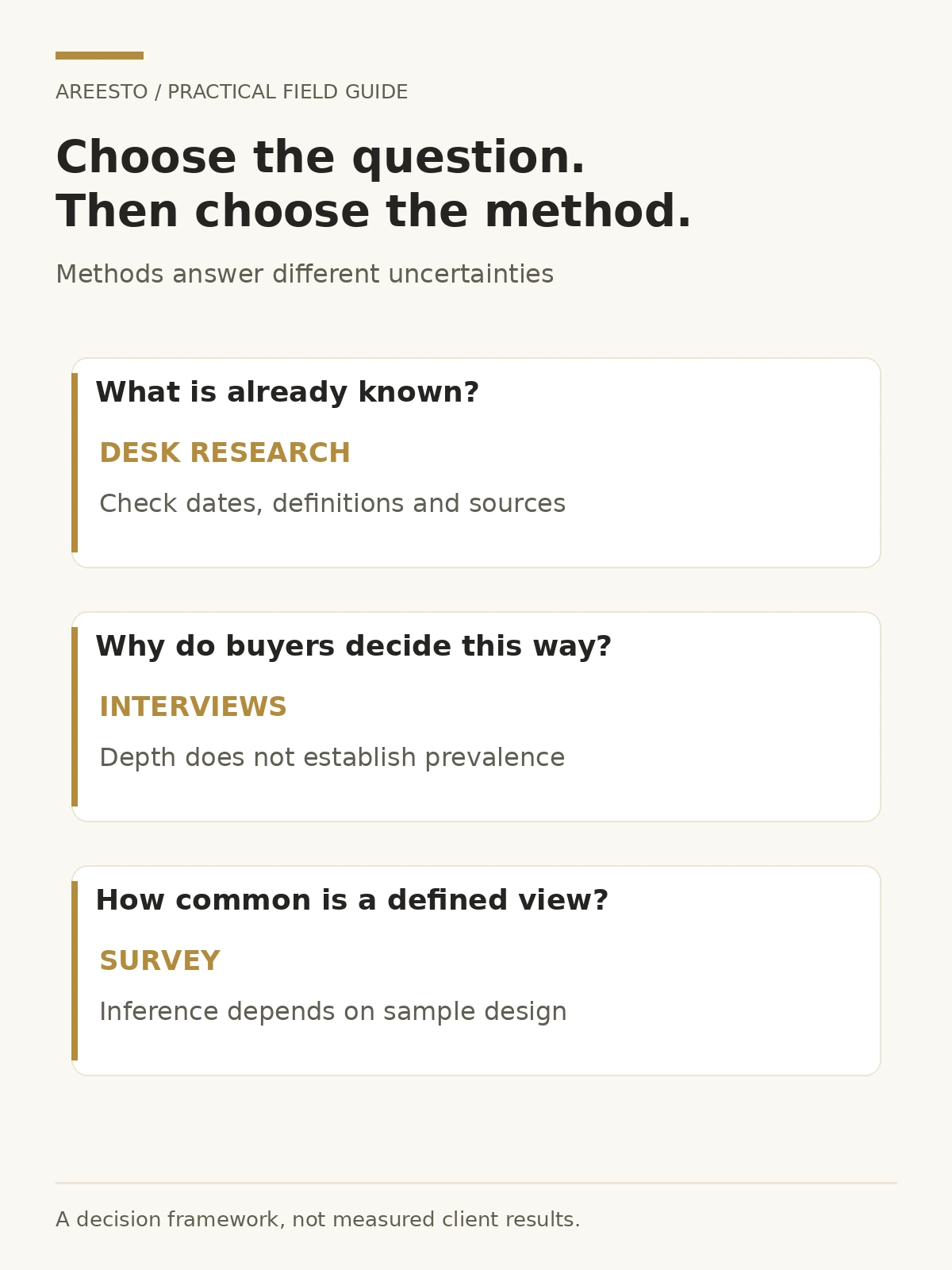
Choose a research method by the question, not by the size of the report. Desk research helps establish what is already known. Interviews explore how and why relevant people decide. Surveys measure clearly defined questions across a specified sample. These methods can work together, but none automatically makes an uncertain launch predictable.
Turn the launch decision into answerable questions
Start with the choice the business must make: whether to enter a category, which segment to serve, how to position the offer or what to change before launch. List the uncertainty behind that choice. A useful research question is more specific than “will customers like us?” It might ask how target buyers currently solve the problem, what stops them switching, or which features they actually understand.
Define the intended population. “UAE customers” is not a sampling plan. Are you studying residents who buy a category, procurement managers responsible for a service, customers of a particular channel or visitors making a short-term purchase? Geography, relevant behaviour and decision role may matter more than a convenient demographic label.
Agree what evidence could change the decision
Write down what you would do differently after the study. If every possible answer leads to the same launch, the project may be a presentation exercise rather than a decision tool. Ask what evidence would justify further investigation, a revised offer or a pause.
The American Association for Public Opinion Research’s best-practice guidance starts with this same discipline: clear objectives, relevant existing information and consideration of whether a survey is the right method at all. It is methodological guidance, not a UAE market forecast.
Use desk research to establish the starting picture
Desk research reviews existing material such as official datasets, company publications, category reports, public offers and your own records. It can reveal definitions, distribution patterns, competing propositions and gaps that a primary study should investigate. It is often a sensible first step because it prevents paying respondents to answer questions that reliable existing evidence already resolves.
But availability is not relevance. Check the date, geography, category definition and source method. A national figure for a broad industry may not describe your niche in Dubai. A competitor’s promotional claim is evidence of its messaging, not independent proof of its market performance.

Keep a source register with the claim, source, publication date, coverage and limitation. Distinguish facts you can verify from estimates and interpretation. Where sources disagree, investigate the definitions instead of averaging incompatible numbers into a deceptively precise market size.
Know when desk research has reached its limit
Public information rarely explains the private reasoning behind a lost purchase. It may not reveal how buyers interpret your new proposition or who influences a procurement decision. Those gaps suggest conversations with relevant people, not another round of searching for a convenient published answer.
Use interviews to understand the buying story
Interviews are useful when you need context, language, objections and a detailed account of a decision. Ask participants about what they did, what alternatives they considered and what happened next. Then probe for clarification. A retrospective account has limitations, but it can reveal uncertainties that a fixed questionnaire would miss.
Recruit people who match the question. Current customers alone may not explain why prospects reject the offer. Friendly contacts may be easy to reach but poorly suited to the decision. In B2B research, distinguish users, technical evaluators, commercial decision-makers and procurement rather than treating every job title as equivalent.
Use the language in which participants can explain their experience comfortably. Arabic and English may be appropriate for a project, but they are not automatically sufficient for every intended audience. Confirm recruitment and language coverage against the population rather than assuming one bilingual template fits the whole UAE.
Qualitative findings explain patterns and possibilities; they do not establish what percentage of the entire market holds a view. Record contradictory evidence and avoid turning a memorable quote into a universal conclusion. Obtain the appropriate permission for recording, quotation and use, and agree how identifiable information will be handled.
Use surveys to measure a defined question
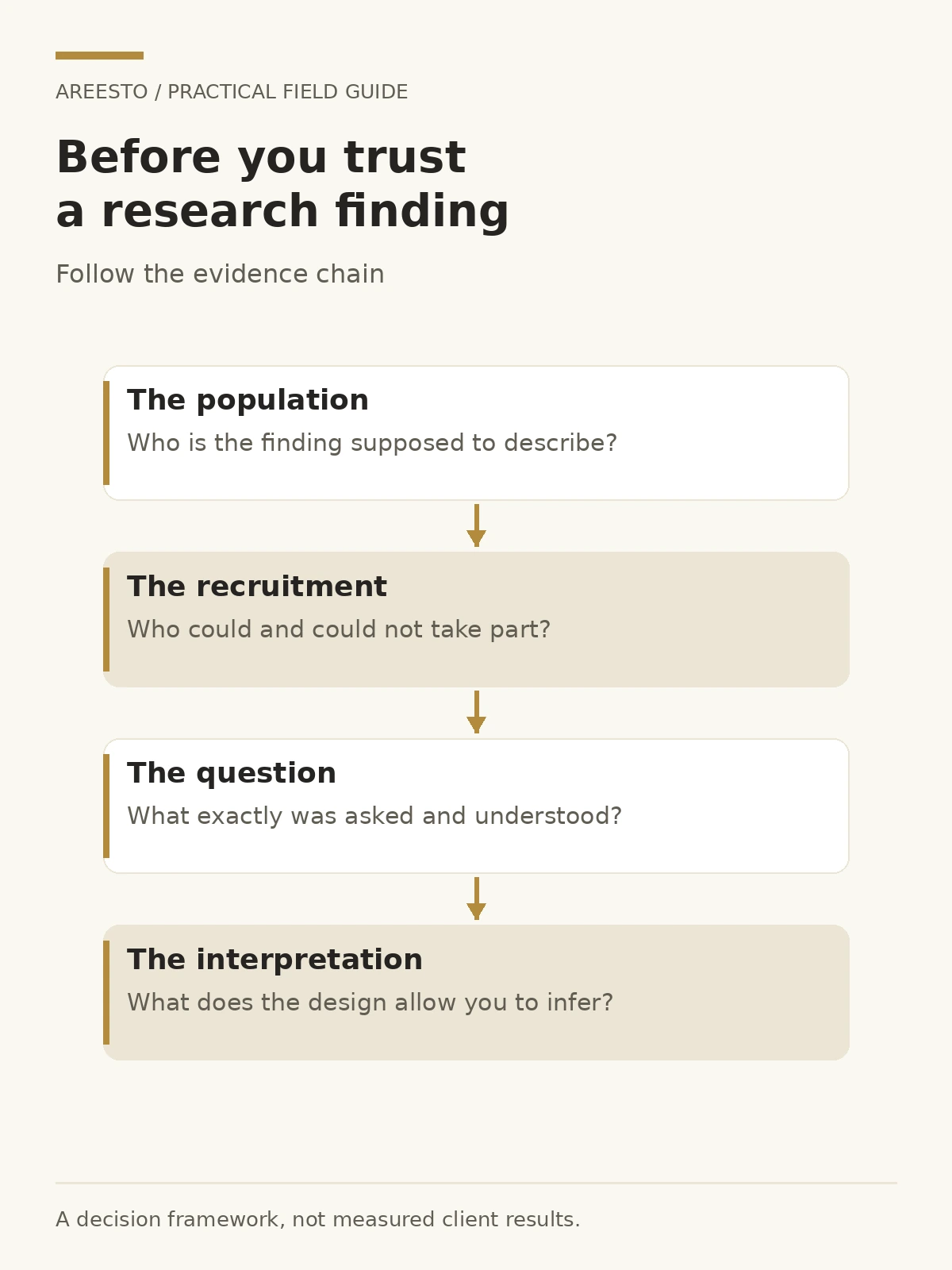
A survey is useful when the concepts are sufficiently clear to ask consistently. It can measure reported awareness, behaviour, attitudes or reactions within the study’s design. Its value depends on who was recruited, what was asked, how questions were presented and how the results are analysed—not simply on the number of completed responses.
A large opt-in response set does not automatically represent the target market. Ask how the sampling frame covers your population, who is missing and which assumptions support any weighting or generalisation. Probability and nonprobability samples require different interpretations; do not attach a conventional margin of sampling error to an opt-in poll without appropriate statistical justification.
Test the questionnaire before launching
Ask one concept at a time, avoid leading language and offer response options that fit the question. Check that respondents interpret terms consistently across languages. A translation can be grammatically accurate while prompting a different interpretation of a product benefit or buying stage.
AAPOR recommends pretesting questions with people similar to the intended respondents and piloting procedures before full fieldwork. Review unclear wording, routing, completion problems and recruitment quality before scaling collection. Do not use the study to manufacture a preferred result or disguise a sales approach as research.
Choose the combination with a decision worksheet
| What you need to learn | Start with | Important limitation |
|---|---|---|
| What reliable information already exists? | Desk research and source review | Definitions and dates may not match your niche |
| Why do buyers choose or reject an offer? | Relevant customer or prospect interviews | Depth is not a population percentage |
| How common is a clearly defined view or behaviour? | A survey with an appropriate sample design | Coverage and recruitment shape what can be inferred |
| Does a new message make sense? | Exploratory interviews, then measurement if needed | Stated preference is not guaranteed purchase behaviour |
A sensible sequence might begin with existing evidence, use interviews to define the relevant buying barriers, and then survey a suitable sample if measuring those barriers would change the decision. That is an example sequence, not a mandatory package. A narrow problem may need only one method.
Before commissioning, request a research brief covering the decision, audience, recruitment, languages, method, quality checks, analysis and deliverables. Ask for limitations to appear in the final report, including what the study cannot establish. Clean tables are not enough if the business cannot see how a conclusion follows from the evidence.
To scope an evidence-led starting point, explore Areesto’s market research services in Dubai and the UAE. Bring the decision you face and what you already know. The method should follow from that conversation, not the other way around.
Frequently asked questions
Should market research always start with a survey?
No. Existing evidence may answer the question, or interviews may be needed to understand the issue before writing a useful questionnaire.
How many interviews do we need?
It depends on the question, audience differences and depth required. Agree the scope and review emerging themes; there is no universal interview count that makes qualitative findings representative.
Does a larger survey guarantee a better answer?
No. Recruitment, coverage, wording and analysis matter. A large biased sample can still give a misleading picture of the intended population.
Can research predict whether a UAE launch will succeed?
Research can reduce uncertainty and challenge assumptions. It cannot remove execution risks or guarantee that stated intentions become purchases.