
Rebranding Without Losing Customers: A Dubai Launch and Migration Checklist

Imagine a customer searching for the familiar business name, following an old proposal link and arriving at a new identity with no explanation. The design may be excellent, but the customer has to work out whether this is still the same company. A rollout plan should remove that uncertainty before the announcement goes out.
A Dubai business should rebrand when its brand no longer matches its strategy: after a merger, a move into new markets or segments, a change in positioning, or when customers consistently misunderstand what it offers. A refresh updates the look; a full rebrand can change name, positioning and identity. Either way, plan the rollout carefully to keep customers and search visibility.
This guide covers the signs, the options and a safe rollout. For a full project, see our rebranding service in Dubai.
When should you rebrand?
Rebrand when there is a business reason, not only because the logo feels old. Good reasons include a merger or acquisition, a new target audience or price position, expansion into other emirates or countries, a name that limits growth, or a reputation problem. If the strategy is still right and only the visuals feel dated, a refresh is usually enough.
- Your services or audience have changed and the brand no longer fits.
- Customers confuse you with competitors.
- You have merged businesses with different brands.
- Your name or identity does not work in Arabic or for new markets.
- Inconsistent materials have made the brand look unprofessional.
Refresh or full rebrand?
| Option | What changes | When it fits |
|---|---|---|
| Brand refresh | Logo details, colours, typography, templates | Strategy is right; visuals are dated or inconsistent |
| Repositioning | Messages, value proposition, tone, some visuals | Audience or offer has shifted |
| Full rebrand | Name, positioning, identity and architecture | Merger, major pivot or a name that blocks growth |

What does a rebrand involve?
- Audit: review current brand perception, materials, competitors and what customers value.
- Strategy: confirm or update positioning and brand architecture.
- Naming (if needed): develop and check a new name.
- Identity: design the new visual and verbal system in Arabic and English.
- Rollout plan: list every touchpoint and decide the order of change.
- Launch: tell staff first, then customers and partners.
How do you keep customers during a rebrand?
Explain the change before customers notice it. Tell existing clients directly, say what is changing and what stays the same, and keep familiar elements where they still help. Train staff to explain the change in one or two sentences. Avoid launching during your busiest season, when confusion costs more.
How do you protect search visibility?
If your name or domain changes, keep the old domain and redirect every old page to its matching new page with permanent redirects. Update your Google Business Profile, social profiles and directory listings, and tell partners who link to you. Monitor Search Console for errors in the weeks after launch.
Which touchpoints need updating in Dubai?
- Trade licence details if the trade name changes.
- Shopfront and building signage, which may need permits.
- Vehicles and branded fleet, which may need approval.
- Website, Google Business Profile, social profiles and WhatsApp Business.
- Uniforms, stationery, invoices, contracts and email signatures.
- Packaging and product labels.
Check the current approval requirements for signage and vehicle branding with the relevant authority before you produce anything.
Common rebranding mistakes
- Changing everything at once without a plan, so old and new brands mix for months.
- Forgetting redirects and losing search traffic.
- Ignoring Arabic until the end.
- Launching externally before staff understand it.
If the rebrand starts with a new name, read our brand naming guide for Dubai. For the visual side, see bilingual brand identity in the UAE.
Who should own the rebrand internally?
Give one person clear ownership, usually someone senior in marketing or operations, with a small group of decision makers who approve each stage. In UAE family businesses and groups, agree early who has the final say, so decisions are not reopened late. The owner should keep a single list of every touchpoint, who is responsible for changing it and the deadline.
What should the rollout plan include?
- Inventory: every place the old brand appears, online and offline.
- Priority: customer-facing items first, internal items later.
- Approvals: licences, signage and vehicle permits with lead times.
- Digital switch: website, redirects, profiles and listings on the same day.
- Communication: staff briefing, client emails, website note and social posts.
- Review: a check after launch for old materials still in use.
A phased rollout is normal, but keep the transition short so customers do not see two brands side by side for long. Budget for production items such as signage and uniforms early, because they often take the longest.
A rebrand readiness checklist
Before you commit budget, answer these questions honestly with your leadership team:
- Can we explain in one sentence why the current brand no longer works?
- Do we have research or customer feedback that supports the change, not only internal opinion?
- Have we agreed what must stay, such as a name customers search for or a recognised colour?
- Do we know every touchpoint and approval that will be affected, including licences, signage permits and vehicle branding?
- Is there a budget for rollout and production, not only for design?
- Who will make the final decision, and by when?
If several answers are unclear, start with a short brand audit rather than a full rebrand.
Example: how a rebrand might be phased for a Dubai service business
Consider a typical services company with an office, a website, branded vehicles and social channels. A sensible sequence could look like this. First, strategy and research define the new positioning and confirm whether the name stays. Second, the identity is designed and tested in Arabic and English. Third, the team prepares all assets, the new website and the redirect map while approvals for signage and vehicles are requested. Fourth, staff are briefed and key clients are told personally. Finally, the digital switch happens on one day, followed by physical items as they are produced, with a review a few weeks later to catch old materials.
This is an illustration, not a fixed template; the timing depends on the size of the business and the approvals involved. A rebranding team can help plan each phase and keep the old and new brands from overlapping for too long.
A practical launch and migration worksheet
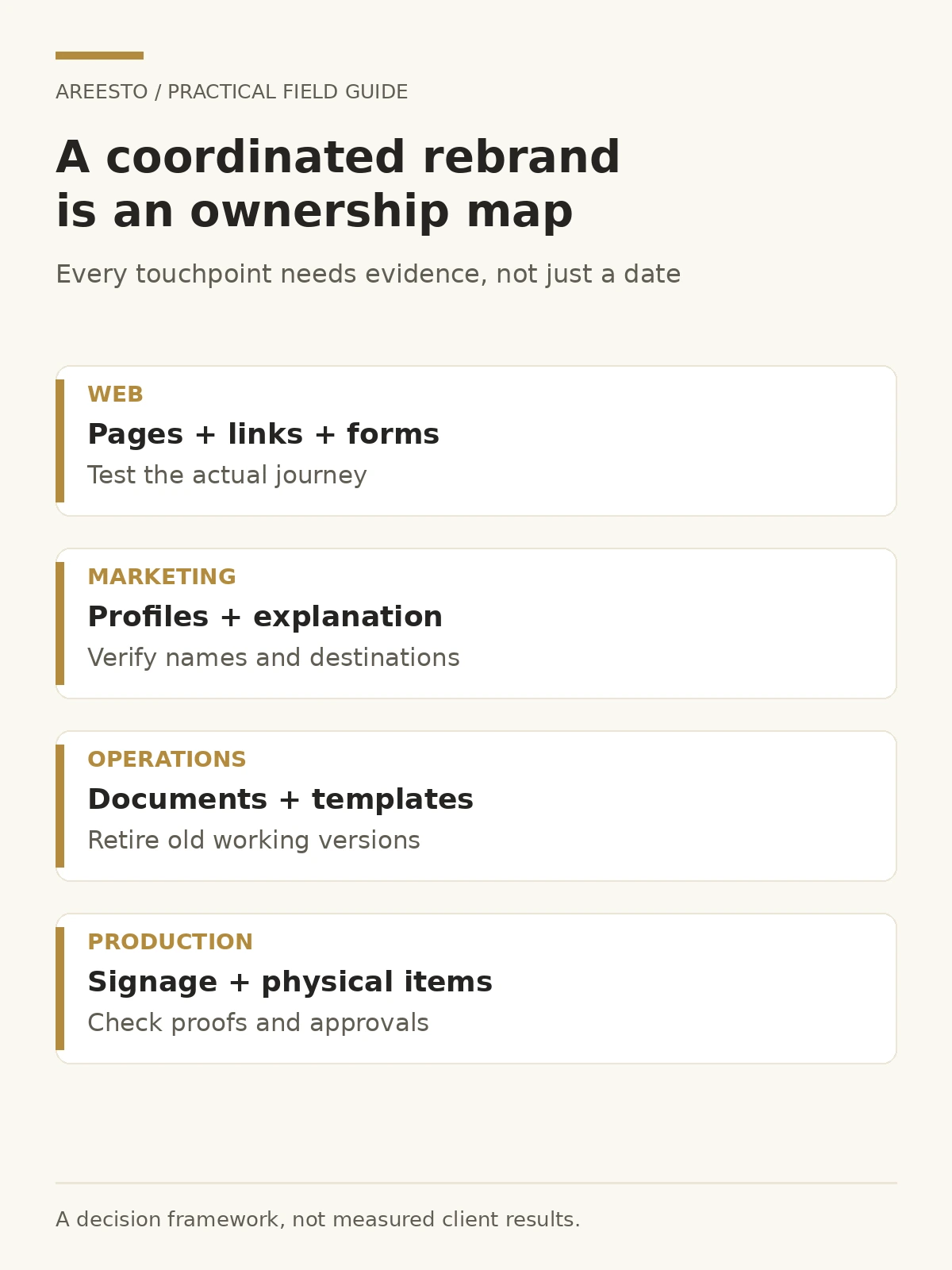
Use a shared release record rather than separate lists held by design, web and operations. Each touchpoint needs an owner, a dependency, approval evidence and a way to check the finished result. A deadline without a responsible person is not a launch plan.
Build the inventory around customer journeys
Start with the places a customer actually encounters the business: a search result, referral, listing, saved email, proposal, invoice, storefront or delivery. Then work backwards to the systems and suppliers that maintain them. A sales document may live in a shared drive, an email attachment, a CRM template and a salesperson’s laptop. Updating only the master leaves the old identity in circulation.
Record what will stay recognisable during the transition and how staff will explain the connection. Do not assume every rebrand requires changing a domain. If the existing URL still serves the business, keep it unless there is a clear reason to move.
| Touchpoint | Responsible role | Dependency | Evidence to check |
|---|---|---|---|
| Website and enquiry flow | Web owner | Approved copy, identity and URL decisions | Working forms, destination pages and mobile layouts |
| Search and public profiles | Marketing owner | Verified business details and platform access | Consistent name, links and customer-facing explanation |
| Proposals and operational documents | Sales and operations owners | Approved templates and factual details | Current exported documents and retired old templates |
| Physical materials | Production owner | Supplier proofs and any applicable approvals | Correct artwork, installation and a replacement record |
Treat a URL change as a separate technical project
Google Search Central’s site-move guidance recommends mapping old URLs to their relevant new destinations, preparing permanent redirects, updating internal links and monitoring the move. It also warns against sending many unrelated pages to a homepage. A redirect should help a visitor reach equivalent content, not merely avoid an error screen.
If URLs change, include downloadable documents and image assets in the review where they have useful incoming links. Check canonical and multilingual annotations with the technical team. Coordinate the timing of any domain, platform and layout changes rather than assuming a new logo requires every technical change at once.
No migration checklist can guarantee unchanged rankings. Google explicitly advises expecting temporary fluctuations while pages are recrawled and reindexed. Record a baseline, test important journeys and agree who investigates unexpected errors. Avoid promising that the new identity itself will preserve or increase search traffic.
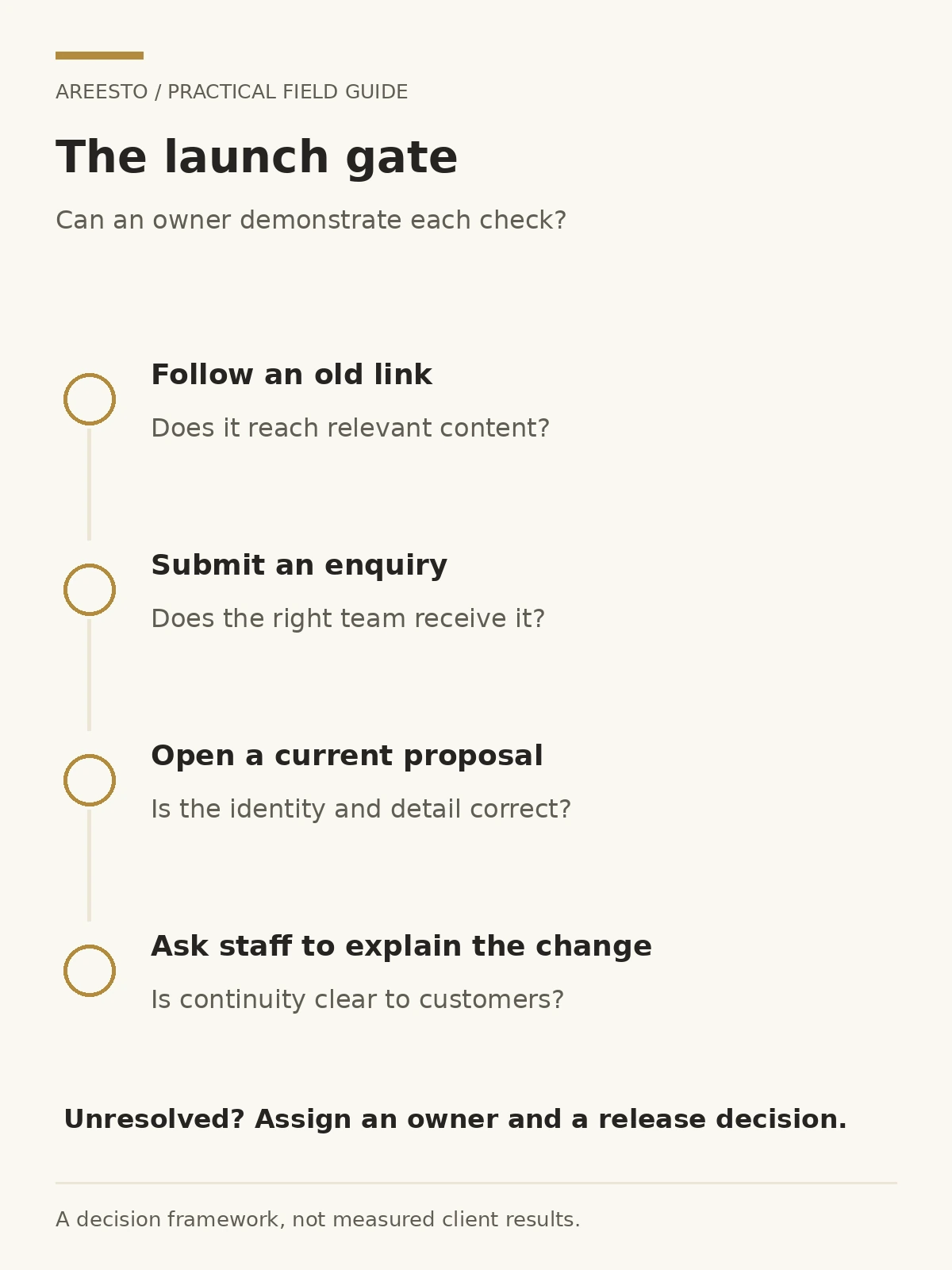
Make launch approval a decision gate
Before public release, ask each owner to demonstrate the completed work. Submit an enquiry, follow a saved link, open a proposal on a phone and ask a staff member to explain the change. Confirm that unresolved issues have an owner and a decision: fix before launch, launch with a documented workaround or postpone the affected element.
After release, keep a short issue log for broken links, customer confusion and old materials still in use. Resolve the cause rather than repeatedly correcting individual files. The result should be a recognisable transition that people can navigate, not simply a date on which the new design was announced.
Key takeaways
- Rebrand for a business reason; refresh if only the visuals are tired.
- Plan every touchpoint, including licences, signage and redirects.
- Tell staff and existing customers first.
Talk to a Dubai branding team
If you want a second opinion on where your brand stands, book a free consultation or message us on WhatsApp. We will look at what you have today and tell you plainly what to fix first.
Frequently asked questions
How long does a rebrand take?
A refresh can be quick; a full rebrand with a new name and many touchpoints takes longer because of naming checks, approvals and production. Plan the rollout as carefully as the design.
Will rebranding hurt my SEO?
It can if old pages disappear. Keep the old domain, redirect each old URL to its new equivalent and update your Google Business Profile and listings while monitoring visibility; unchanged rankings are not guaranteed.
Do I need to change my trade licence when I rebrand?
A trade-name change may require updates to your business records. Confirm the current process with your licensing authority or free zone before implementing it.
Should I keep elements of my old brand?
Often yes. Keeping a colour, symbol or tone that customers recognise can make the transition smoother, as long as it fits the new strategy.
How do I announce a rebrand?
Tell staff first, then key clients directly, then the wider market through your website, social channels and email, explaining why you changed and what stays the same.
How much does a rebrand cost in Dubai?
It depends on scope: a visual refresh costs far less than a new name, identity and full rollout across signage, vehicles and digital channels. Ask for a quote that separates strategy, design and production.
Can we rebrand without changing our name?
Yes. Many rebrands keep the name and change positioning, visual identity and messaging. This protects recognition and search visibility while still signalling change.
What should we do with old brand materials?
List them during the audit, set a cut-off date, and replace customer-facing items first. Keep a few samples for your archive, and make sure staff know not to reuse old templates after launch.
How do we measure whether the rebrand worked?
Compare a few indicators before and after launch, such as branded search, enquiry quality, sales conversations and customer feedback. Agree these measures before the launch so the review is fair.