
Café Branding in Dubai: How to Build a Café People Choose Every Day
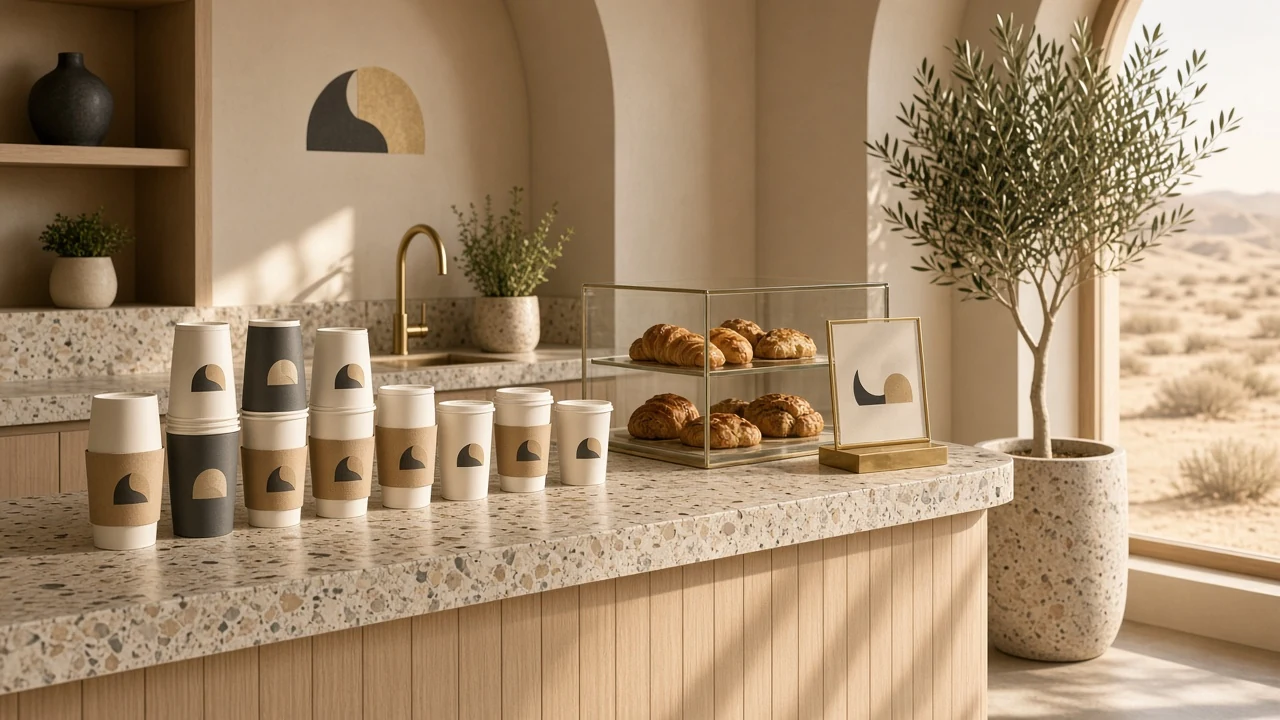
Dubai’s café scene moves fast. New specialty spots appear in residential towers, courtyards, beach strips and business parks, many with excellent beans, careful baristas and handsome interiors. That is exactly why café branding in Dubai has become a serious business decision: when the coffee is good everywhere, people choose the place that feels like theirs.
This guide is for founders opening a first café, owners refreshing an existing one and teams planning a second location. It walks through the decisions that turn a nice-looking café into a brand people seek out, photograph, recommend and return to.
A café brand is a feeling with a system behind it
Customers rarely describe a café by its logo. They say it is “the quiet one where I can work”, “the place with the pistachio croissant”, “where we go after the school run” or “the one with the courtyard”. Those descriptions are the brand. The visual identity, the menu, the playlist and the way staff say hello either support that feeling or contradict it.
So the first branding question is not what the logo should look like. It is what role your café should play in someone’s day.
Step 1: Define the ritual you want to own
Every successful café is attached to a routine. Think about the ritual you want to become part of:
- The morning pass-through. Fast, reliable, friendly and easy to order on the move.
- The slow weekend. Space, comfort, brunch and a reason to stay longer.
- The work session. Good seating, quiet corners, sockets and a menu that suits long visits.
- The destination. A signature drink, a striking space or an origin story that makes people travel across the city.
- The neighbourhood living room. Familiar faces, community events and a sense of belonging.
You can serve several of these, but one should lead. That choice shapes your location, layout, menu, pricing, opening hours, music and, eventually, your visual identity. It also prevents the most common café branding problem: a concept that tries to be everything and ends up feeling generic.
Step 2: Find the story only you can tell
Specialty coffee has a rich vocabulary of origins, roasts and brewing methods. Many cafés use the same words. Look for the angle that is genuinely yours: a founder’s journey, a heritage recipe, a connection to a particular origin, a focus on a regional ingredient such as dates or cardamom, a design philosophy or a commitment to a type of customer.
Keep the story specific and true. A short, honest explanation of why the café exists often lands better than a grand narrative. If you are working on the wider positioning for a food business, our article on brand positioning for restaurants in Dubai applies equally to cafés.
Step 3: Choose a name that works on a cup
A café name has to perform in tiny spaces: a cup sleeve, a delivery app tile, a sticker, a map pin and a social handle. It should be easy to say when a friend recommends it and easy to search when someone tries to find it later.
Test shortlisted names in both Arabic and English, check how they look in each script and confirm trade-name and trademark availability with the relevant authorities and advisers before you commit. Our brand naming service in Dubai covers this process in detail.
Step 4: Build an identity that behaves well in small sizes
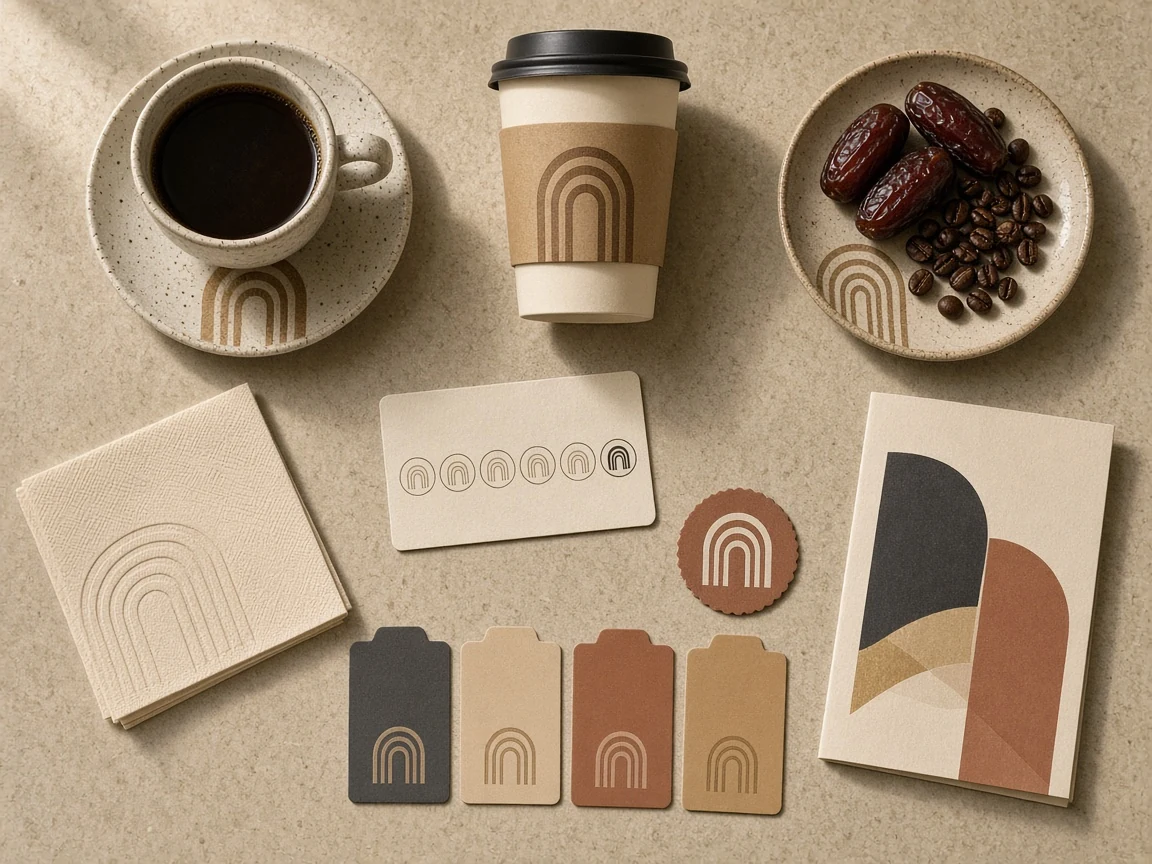
Café identities live on small, busy surfaces. A mark that looks beautiful on a presentation board can become unreadable on a cup lid or a loyalty card. When you develop the visual identity, ask to see it on the real objects:
- Takeaway cups, sleeves, lids and stickers
- Menu boards, counter cards and the digital menu
- Pastry bags, boxes and delivery packaging
- Staff aprons, uniforms and name badges
- Signage by day and by night
- Social posts, stories and the delivery app thumbnail
A flexible system with a primary logo, a simpler mark, a small set of colours, one or two typefaces and a pattern or illustration style usually works better than a single rigid logo. It gives the team room to create fresh content without drifting off-brand.
Step 5: Design the space as part of the brand
In a café, the interior is not a backdrop; it is one of the main brand touchpoints. Materials, lighting, seating, music and even the sound of the grinder all communicate something. Brief your interior designer and your branding team together so the space and the identity grow from the same idea rather than competing with each other.
Think about the moments customers photograph: the counter, a signature wall, a window seat or the way a drink is presented. These moments should feel natural, not forced. A space designed only for photos can feel uncomfortable to actually sit in.
Step 6: Make the menu a brand tool
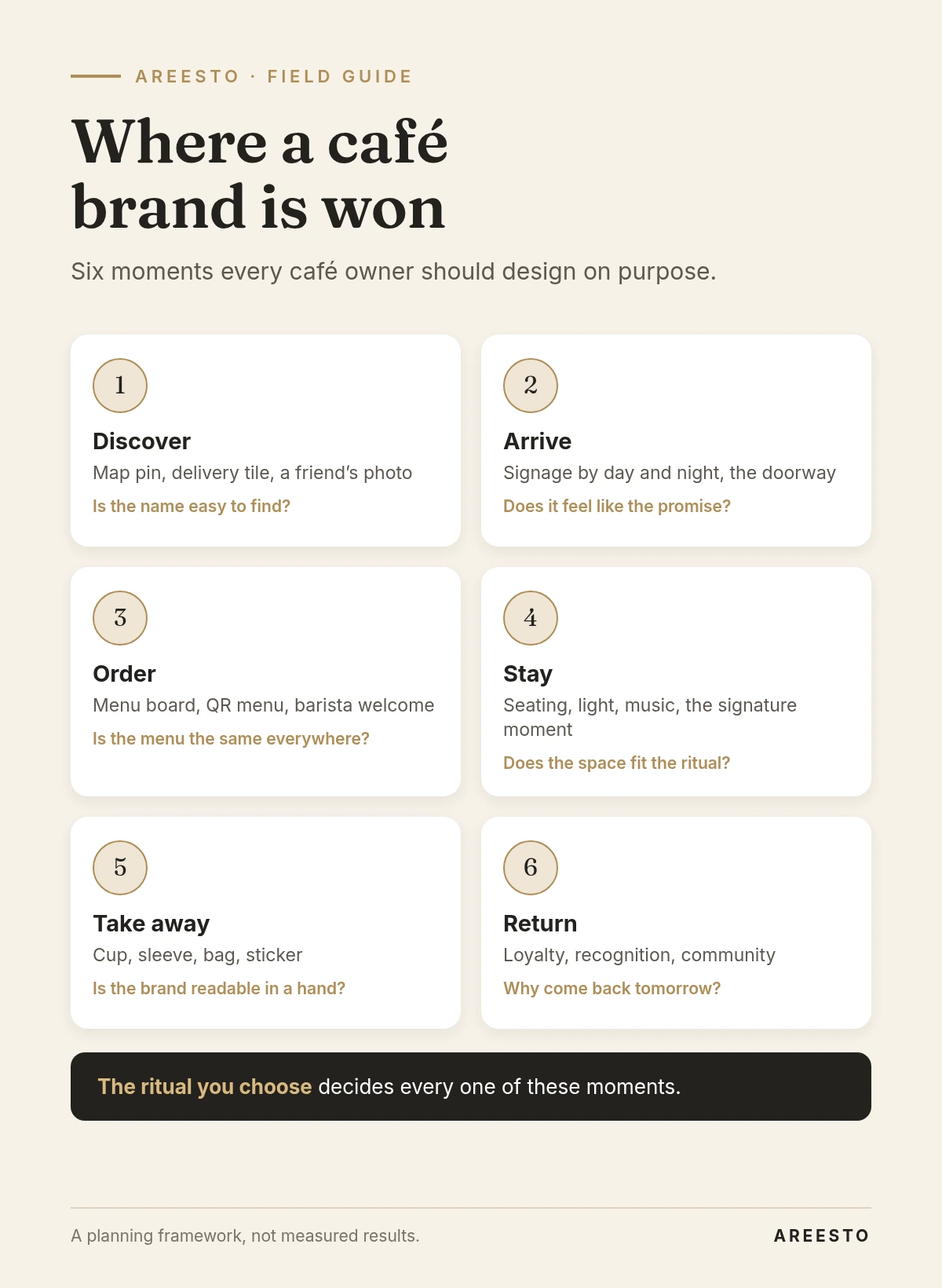
The menu is where many café brands become confusing. Long lists, inconsistent names and different versions across the counter, the QR menu and the delivery app quietly damage trust. Keep the core menu focused, name signature items in your brand voice and make sure every channel shows the same information.
If you run dine-in, takeaway and delivery, our guide to keeping menus consistent across dine-in, delivery and digital ordering offers a practical method that works just as well for cafés.
Step 7: Treat packaging as your travelling sign
Every takeaway cup and pastry bag that leaves the café carries your brand across the city. Packaging has to protect the product, suit delivery and look intentional in someone’s hand or on an office desk. Bilingual information, ingredient or allergen details where needed and clear handling instructions all need to fit without crowding the design.
Our article on Arabic and English packaging design explains how to balance two languages with one distinctive look, and our packaging design service in Dubai covers production-ready development.
Step 8: Train the brand into the team
Baristas are the voice of a café brand. The welcome, the way recommendations are offered, how a mistake is handled and even how orders are called out all shape what customers remember. Write a few simple service principles that reflect the brand, show staff what good looks like and make the brand part of onboarding rather than a poster in the back room.
Step 9: Launch locally, then grow with care
A café usually earns its first loyal customers within walking or short driving distance. Make the launch about the neighbourhood: local listings, Google Maps information that is accurate and complete, community partnerships and a reason for nearby residents and workers to try you. Social media and influencer visits can help, but they work best when the experience is already consistent.
When you plan a second location, decide what must stay identical and what can adapt to the new neighbourhood. A clear brand system makes expansion easier because the team knows which elements are non-negotiable. For broader launch and growth planning, see our restaurant and café marketing in Dubai service.
How to tell whether your café brand is working
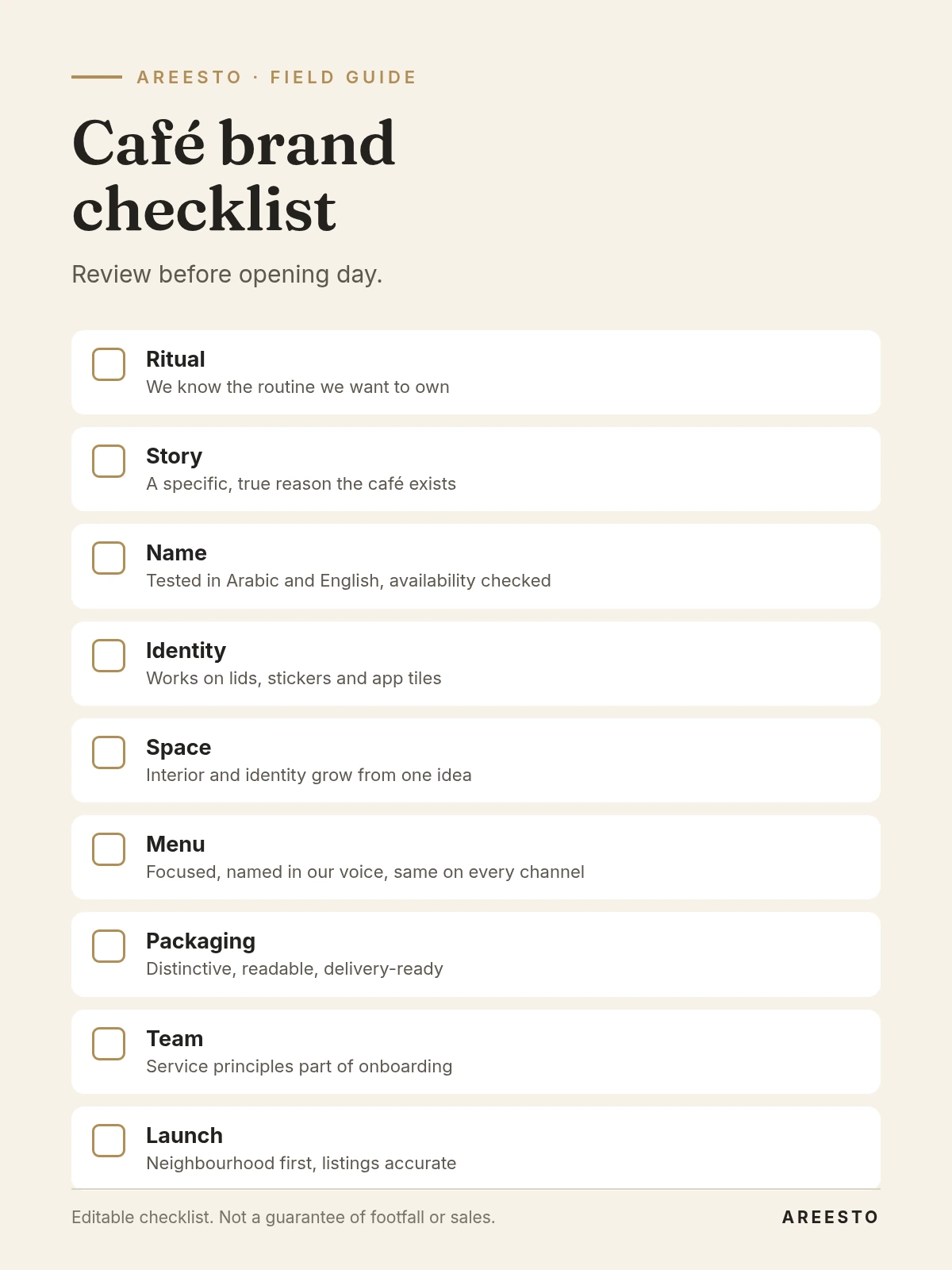
Footfall and sales matter, but they are influenced by location, season, pricing and operations as much as by branding. Look for brand-specific signals too. Do customers describe the café the way you intended? Do reviews mention the ritual you designed for, such as the calm morning, the work corner or the signature drink? Do people recognise your cup in a photo before they see the name? Do staff explain the concept confidently without a script?
Collect these observations regularly, from reviews, social comments, staff feedback and short conversations with regulars. If the description customers use drifts away from your intended role, that is the moment to adjust the experience or the message, calmly and deliberately, rather than redesigning everything at once.
Café branding mistakes to avoid
- Following a trend instead of a ritual. Trends fade; routines keep customers coming back.
- Designing the logo before the concept. Without a clear role, the identity has nothing to express.
- Letting the delivery app look like a different café. Inconsistent photos and names confuse returning customers.
- Overcrowding packaging. A cup is not a brochure; keep it distinctive and readable.
- Forgetting the night-time view. Many cafés are discovered after dark; test signage and lighting.
How Areesto helps cafés
We work with founders on the full picture, from concept and positioning to naming, identity, menu, packaging and launch. Our restaurant and café branding service in Dubai is designed for food and beverage concepts that want a distinctive presence and a system their team can run every day.
Frequently asked questions
What does café branding include?
Café branding usually covers concept and positioning, naming, visual identity, menu design, packaging, signage, interior direction, tone of voice and launch communication. The aim is a consistent experience across every touchpoint.
When should I start branding my café?
Ideally before you finalise the interior and packaging orders. Branding decisions influence the space, the menu and printed materials, so starting early helps avoid costly changes.
Should my café brand be in Arabic and English?
If your customers read both languages, plan both from the start. The name, signage and packaging should work well in each script rather than relying on a late translation.
How is café branding different from restaurant branding?
The principles are similar, but cafés depend more on daily rituals, small surfaces like cups and stickers, takeaway and frequent repeat visits. That makes consistency in small details especially important.