
Test the Message Before Buying the Media: Customer Interviews for UAE Campaigns

Imagine the campaign review. The headline looks confident, the visuals feel polished and everyone in the room knows exactly what the business means. Then someone outside the project reads it and describes a different offer. The media plan is ready; the message is not.
Customer interviews can reveal how intended buyers interpret a campaign before you pay to distribute it widely. Test what people understand, believe and expect to happen next—not simply which version they like. This is qualitative message testing: useful for diagnosing confusion and improving a proposition, not for predicting a market-wide conversion rate.
Recruit people who fit the actual buying decision
Begin with the decision your campaign supports. A person who uses the service, someone who recommends suppliers and a procurement reviewer may read the same message differently. Define whose understanding matters and recruit accordingly. General interest in a sector is not the same as relevant buying experience.
Write a short recruitment screen around that experience. Ask about the participant’s role in a recent or plausible purchase, the kind of problem involved and the language they would normally use at that stage. Do not put the preferred answer into the invitation. Recruiting only enthusiastic customers or colleagues can hide the assumptions a new prospect will not share.
Keep the findings in proportion to recruitment. A deliberately selected interview group can uncover meanings, doubts and vocabulary. It does not establish how common an opinion is across UAE buyers. More conversations with the same narrow network will not automatically make the results representative.
Explain participation, how responses will be used and whether recording is proposed. Keep identifying information limited to what the research actually needs and agree appropriate handling. Participation in research should not quietly become a sales call. AAPOR’s research best practices emphasise method choice, non-leading questions, pretesting and transparency; do not borrow the authority of survey research to overstate an exploratory interview exercise.
When scoping fieldwork and participant research in Dubai, specify the buying role and uncertainty first. “Find people to review our ads” is a weaker brief than “Understand whether the intended decision-maker recognises the offer and its limitations.”
Ask about understanding before asking preference
Show a realistic message stimulus: the actual headline, supporting copy, visual and intended next action in a readable format. Explain only the context a real viewer would have. If you deliver a long verbal introduction, you may be testing your explanation rather than the campaign.
Start with unaided interpretation. Ask the participant to describe what they think is offered, who it seems relevant to and what they remember. Then explore the wording or image that led them there. Resist correcting a misunderstanding immediately; the misunderstanding is evidence about the message.
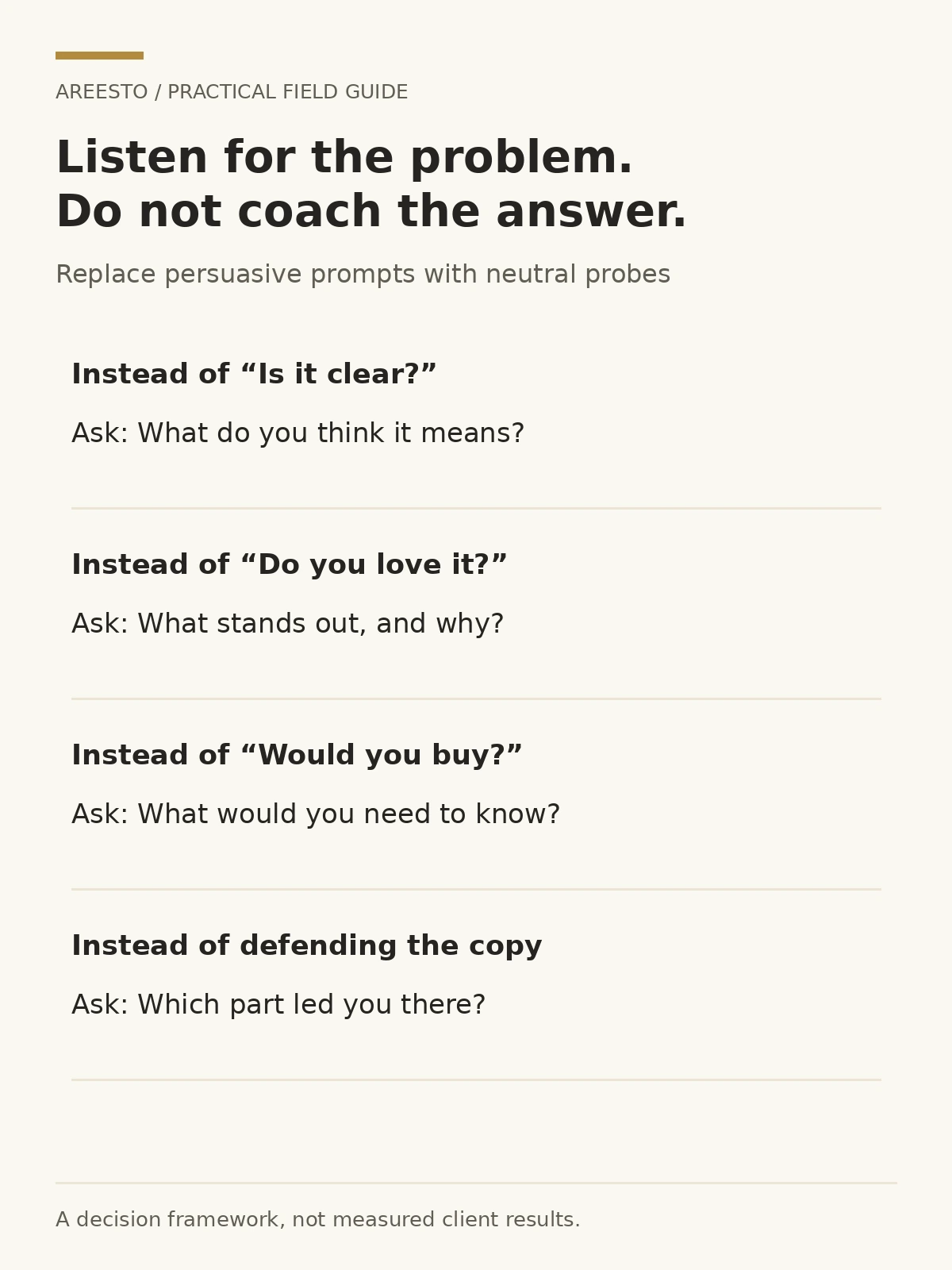
Move from meaning to credibility. Ask what feels clear, uncertain or unsupported and what information would be needed to judge the offer. “Does this sound trustworthy?” can invite a polite answer. A more useful discussion examines the specific claim, the expected evidence and any unanswered question.
Preference can come later, with reasons. A participant might like a dramatic headline while misunderstanding the service. Another might dislike a visual treatment but correctly understand an important distinction. Record those findings separately rather than selecting the most popular artwork as the strategy.
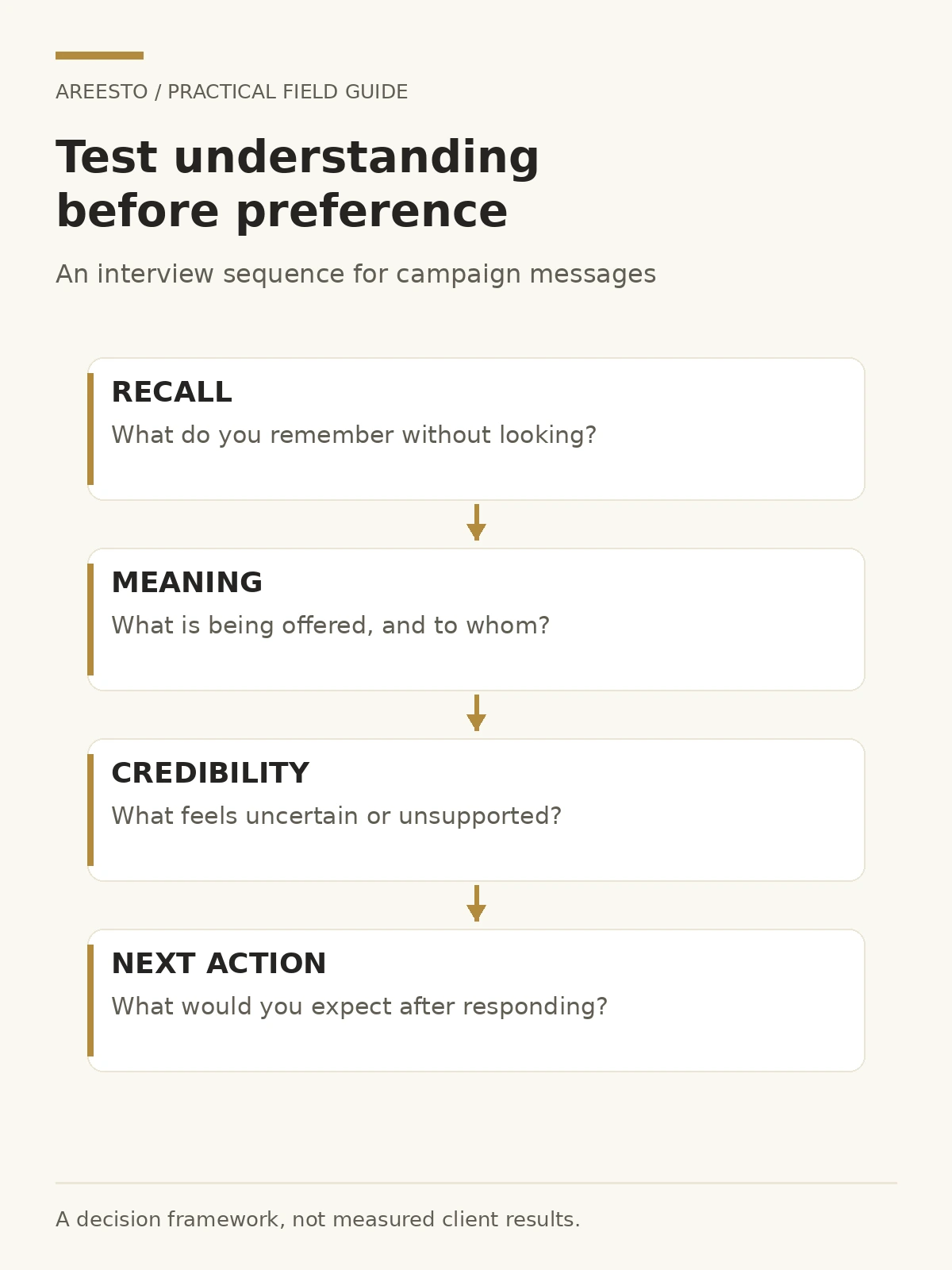
| Purpose | Neutral prompt | What to record |
|---|---|---|
| Understanding | What do you think this is offering? | Interpretation before explanation |
| Relevance | Who does this seem intended for? | Audience assumptions and exclusions |
| Credibility | What would you need to know to judge this? | Missing evidence and doubts |
| Action | What would you expect after responding? | Expectations about contact or purchase |
Test Arabic and English meaning without leading the answer
Decide which buying situations require which language. The same person may browse in English, discuss details in Arabic and compare a technical specification in another context. Language preference is not a reliable shortcut for nationality, purchasing power or intent.
Use a proficient interviewer and reviewed materials for each language. Check that the question’s purpose survives adaptation. A neutral English prompt can become a leading Arabic prompt if its wording suggests approval. Pilot the guide before the main interviews and record any revisions so the team knows which version was used.
Do not assume matching words mean matching meaning. Explore how participants describe the offer in their own language, the associations a phrase carries and whether the expected next step is the same. Keep a terminology record for important service names and claims. Have a language reviewer distinguish a genuine meaning problem from a stylistic preference.
If comparing alternative messages, consider order effects. A participant who has already heard the full proposition may interpret the next version with information it does not contain. Use an appropriate presentation order and keep its limitations visible. The aim is to understand interpretation, not to stage a contest with a predetermined winner.

Turn recurring objections into specific revisions
Keep a finding log that separates observation, interpretation and recommendation. “The participant expected an immediate quotation” is an observation if that is what was said. “The call to action overpromises speed” is an interpretation. “Explain the scoping step before the form” is a proposed revision. Combining all three into a single confident sentence can conceal uncertainty.
Code findings by problem: unclear audience, misunderstood scope, missing evidence, inappropriate tone or unexpected next action. Preserve contrary interpretations as well as recurring ones. A single serious misunderstanding of a limitation can matter even when it is not the most frequent comment.
Prioritise revisions by the decision they affect. Fix wording that changes the perceived offer before polishing adjectives. Add substantiated proof where a claim needs support; do not invent a testimonial to answer a trust objection. If the service cannot fulfil the expectation, change the promise rather than making the same promise more persuasive.
After a material revision, check the changed message again with suitable participants. Do not assume a shorter headline solves the original confusion. Record what was changed, why it was changed and what remains uncertain. This produces a usable learning record instead of a folder of interview recordings nobody revisits.
Use the learning before media planning—and know its limits
Carry the revised meaning through the landing page, form and sales explanation. A clear ad can still lead to disappointment if the next page introduces a different offer. Share the findings with the people handling enquiries, not only the creative team.
Separate this exercise from a campaign experiment. Interviews explain how people interpret a stimulus in a research setting. A live test observes behaviour under actual delivery conditions. Neither should be presented as a guarantee of sales, and neither replaces an accurate offer or capable follow-up.
Decide what evidence is needed next. If the remaining question concerns prevalence, an appropriately designed survey may be relevant. If it concerns actual response, a carefully planned behavioural test may be more useful. Do not keep conducting interviews merely because the method feels familiar.
A useful commissioning brief ends with an action: the message decision to make, the buyers to hear from and the materials to revise. Bring that brief to a discussion about campaign-focused customer research before the creative is treated as final.
Frequently asked questions
Can interviews predict which ad will sell best?
Not on their own. They can diagnose interpretation and objections, but stated reactions in a selected group do not establish market-wide buying behaviour.
Should I ask which message people prefer?
You can, but first test what they understand and why. Preference without comprehension can lead to choosing attractive copy that communicates the wrong offer.
How many interviews are enough?
There is no universal count for every decision. Recruitment breadth, question complexity and the remaining uncertainty matter. Report the design and limitations rather than implying representativeness.
Should Arabic and English use the same interview guide?
Keep the underlying questions comparable, but adapt and pilot the wording. Use proficient interviewers and record how language-specific meaning was checked.