
Clinic Content Beyond Before-and-After Photos: Answer the Questions Patients Need

A clinic’s most useful content may be quieter than its most dramatic image: a clear explanation of the first appointment, a readable introduction to the clinician or a walkthrough that shows someone where to arrive. These are ordinary questions, but unanswered ordinary questions can make the next step feel uncertain.
Build clinic content around what patients need to understand before contacting the practice. Use clinically reviewed explanations, accurate practical information and a controlled publication process instead of relying on treatment transformations as the main story. This is an educational content-planning framework, not individual medical advice or a guarantee of advertising compliance.
Map questions before the first appointment
Start with the points where someone needs orientation. What does an appointment involve? Which clinician handles the initial discussion? How can the clinic explain the booking process without suggesting that a treatment is appropriate before assessment? Separate practical questions from questions that require an individual clinical conversation.
Ask reception and clinical teams which questions they repeatedly need to clarify, then review the wording without collecting unnecessary patient details. A question list should not become an informal copy of someone’s health record. Work with anonymised themes through the clinic’s approved process and have the appropriate clinical owner judge what can safely be answered publicly.
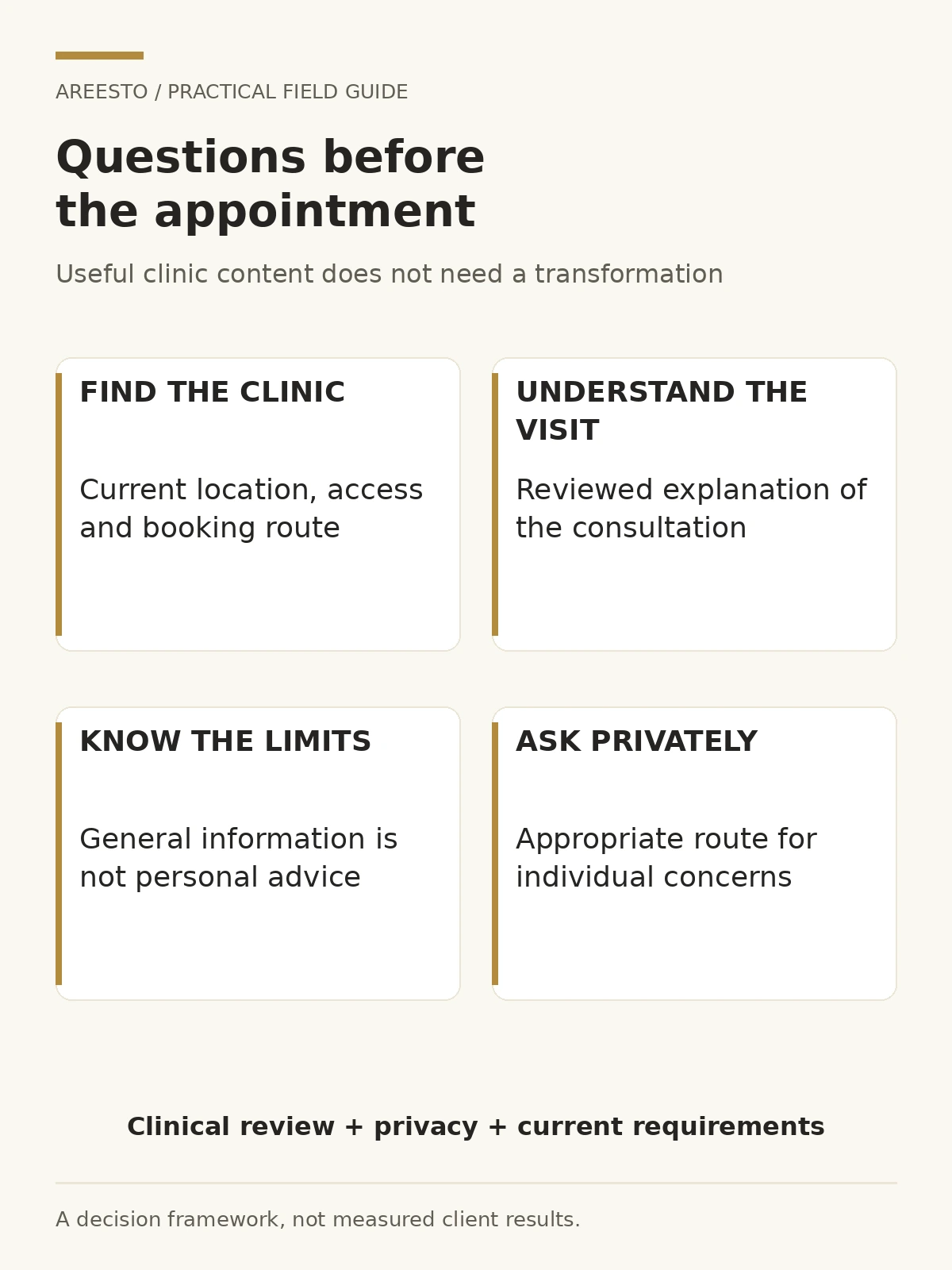
Group the topics by purpose: finding the clinic, understanding the consultation, recognising the limits of general information and knowing how to raise a concern privately. A public article can explain a process without recommending a procedure to a particular reader.
When briefing healthcare marketing support in Dubai, specify the question and the review owner for each asset. “Make reassuring content” is less useful than “Explain the first consultation accurately, without implying a guaranteed treatment plan.”
| Question type | Useful content | Review boundary |
|---|---|---|
| Before visiting | Location, access and booking explanation | Verify current operational details |
| During consultation | Clinician-reviewed process explainer | No individual diagnosis or outcome promise |
| Choosing whom to contact | Accurate clinician and service information | Verify credentials and scope before publication |
| Private concerns | Appropriate confidential contact route | Do not invite health details in public comments |
Use clinician explainers and walkthroughs with a defined job
A clinician explainer should answer a focused question in understandable language. Agree the message before filming and leave room for relevant limitations. A confident delivery does not make a statement clinically sound, and a short format does not justify removing context that changes its meaning.
Walkthroughs can show practical orientation rather than procedures: the entrance, reception route or a suitable empty consultation setting. Plan filming so records, screens, voices and people are not captured incidentally. A space that looks empty in the main frame may still contain identifying information in the background or soundtrack.
Use visual and written versions together where useful. A captioned explanation, a plain-language page and a concise reception answer can share approved facts without being identical scripts. W3C’s caption guidance explains why meaningful speech and relevant non-speech sound need accurate text equivalents. Review captions rather than assuming automatic transcription is correct.
For Arabic and English editions, use competent language review as well as clinical review. Check that a qualification, warning or uncertainty is not softened during adaptation. Keep the versions linked in the content register so an update to one does not leave the other communicating an outdated explanation.
Separate education from promotion without inventing an exemption
Calling a post “educational” does not automatically settle how advertising rules apply. A clinic-branded explanation may still promote a service or create an expectation. Have the responsible reviewer assess the actual message, context and distribution, not only the label attached by the marketing team.
DHA’s official social-media advertising circular directs the relevant Dubai facilities and professionals to its standards. The published standards address misleading claims, patient privacy and review responsibilities. Confirm the currently applicable version and requirements for the actual facility and content before release; this article is not a substitute for that assessment.
A practical editorial boundary is to explain what the service involves without asserting that it is best, risk-free or certain to deliver a desired result. Do not turn an individual outcome into a promise for another person. Equally, do not use fear or an unsupported suggestion of illness to make an ordinary reader feel compelled to book.
Before-and-after material is not the only way to communicate, and excluding it does not automatically make the rest of a campaign acceptable. The purpose here is to build a broader, useful information programme—not to provide a workaround for restrictions on promotional content.

Build clinical review, privacy and permissions into production
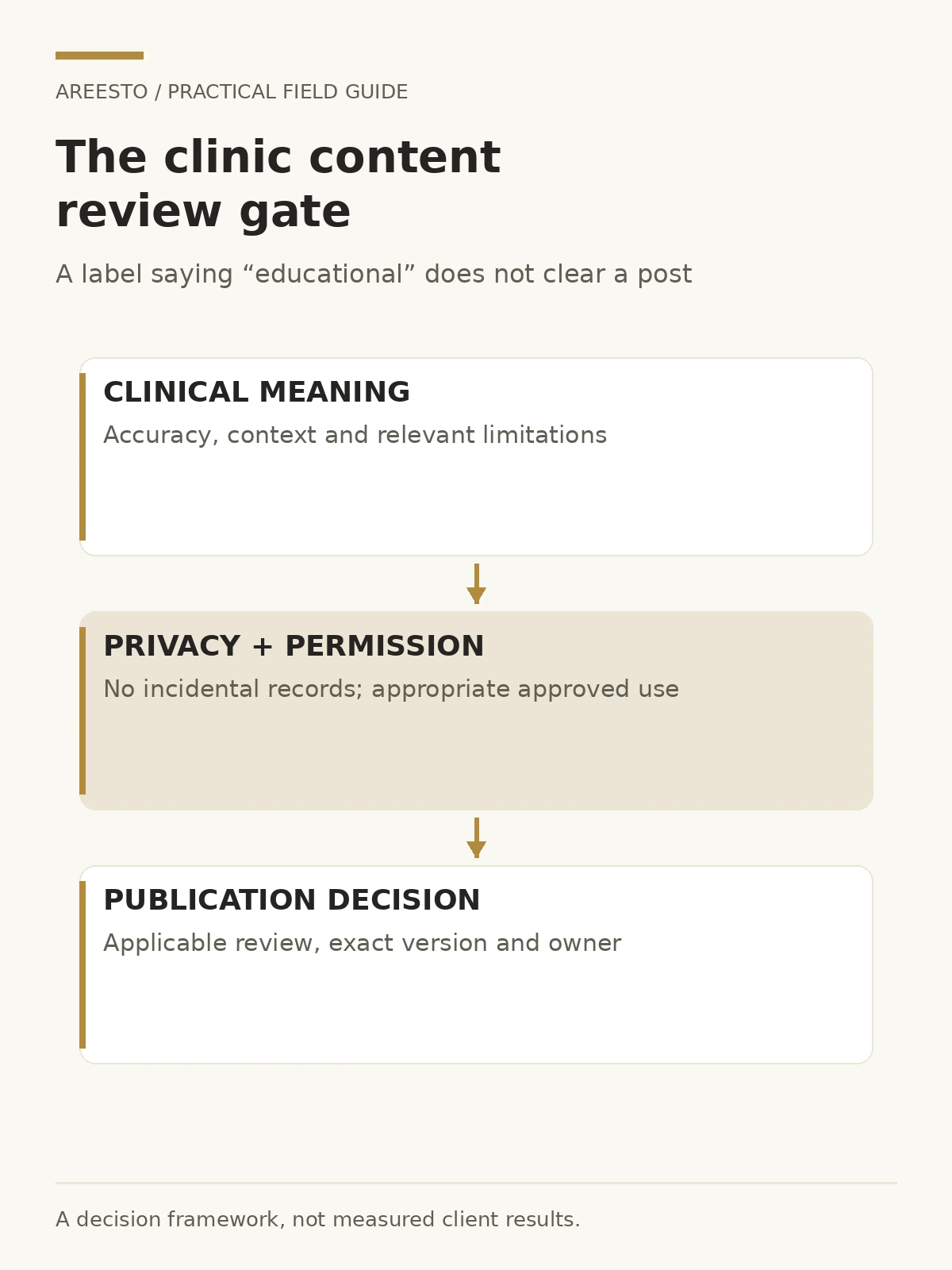
Give each item a clinical owner, a factual source and a publication decision. Where the DHA standards’ medical-director approval provisions apply to promotional material identifying a facility, route it through that review rather than treating marketing approval as sufficient. Record which version was actually reviewed.
Do not assume consent to treatment is permission to use someone in marketing. DHA’s patient-consent guidelines specifically address separate written consent for pictures, images, videos and statements used in social-media advertising. Consent does not erase other content restrictions or replace the clinic’s obligation to assess appropriate use.
Keep identifiable information out of general planning documents unless it is genuinely needed and appropriately controlled. The UAE government’s data-protection overview identifies both general and health-sector frameworks. Which provisions govern a particular workflow needs competent review; a generic marketing checklist cannot determine that for every clinic.
For comments and direct enquiries, establish a safe route into the clinic’s approved communication process. Do not diagnose in a public thread or encourage people to upload records to a marketing account. Give the responding team clear boundaries and an escalation owner.
Maintain a useful content library, not a one-off campaign
Keep a register with the question answered, the approved file, language editions, reviewers and reasons to revisit it. A change in clinician, service scope, booking process or relevant guidance should trigger review. Do not keep reusing a clip solely because the production still looks polished.
Test the practical information too. Follow the booking link, confirm that the receiving team understands the content and check that a language route is actually supported. Clear expectations should continue after the page or video, not disappear when someone contacts reception.
Review usefulness through appropriate questions: is the information current, are common uncertainties addressed and can staff use the approved explanations consistently? Do not promise that an educational library will produce a particular booking increase or treat patient interaction as unrestricted marketing data.
Start with a question inventory and a review workflow, then discuss a clinically reviewed clinic-content plan. The strongest brief is not “more dramatic content”, but “better information with clear boundaries and accountable ownership”.
Frequently asked questions
Can a clinic create useful content without patient transformations?
Yes. Practical orientation, reviewed clinician explanations and clear appointment information can address real questions. Each item still needs appropriate content and publication review.
Is educational content automatically exempt from advertising rules?
No automatic exemption should be assumed. The actual content, branding, distribution and applicable framework need assessment by the responsible reviewers.
Does treatment consent cover social-media advertising?
Do not assume it does. DHA’s patient-consent guidelines address separate written consent for relevant patient material used in social-media advertising, alongside other applicable requirements.
Can this checklist certify that a clinic campaign is compliant?
No. It is a planning framework. The clinic’s clinical, operational and appropriate legal or regulatory reviewers must assess the actual material and current requirements.