
A Better Video Brief: Plan a UAE Brand Shoot Around the Content You Actually Need

Imagine the editing room after a polished brand shoot. The lighting is beautiful and the footage is sharp. Then the requests arrive: a vertical explanation, a silent website loop, an Arabic version and a demonstration nobody filmed. The shoot produced impressive material, but not the material the business needed.
A useful video brief connects each deliverable to a customer question, identifies what can truthfully be shown and specifies the formats, languages and rights needed for release. Plan the edit before the camera arrives. A list of locations and a mood board are useful inputs, not a complete production strategy.
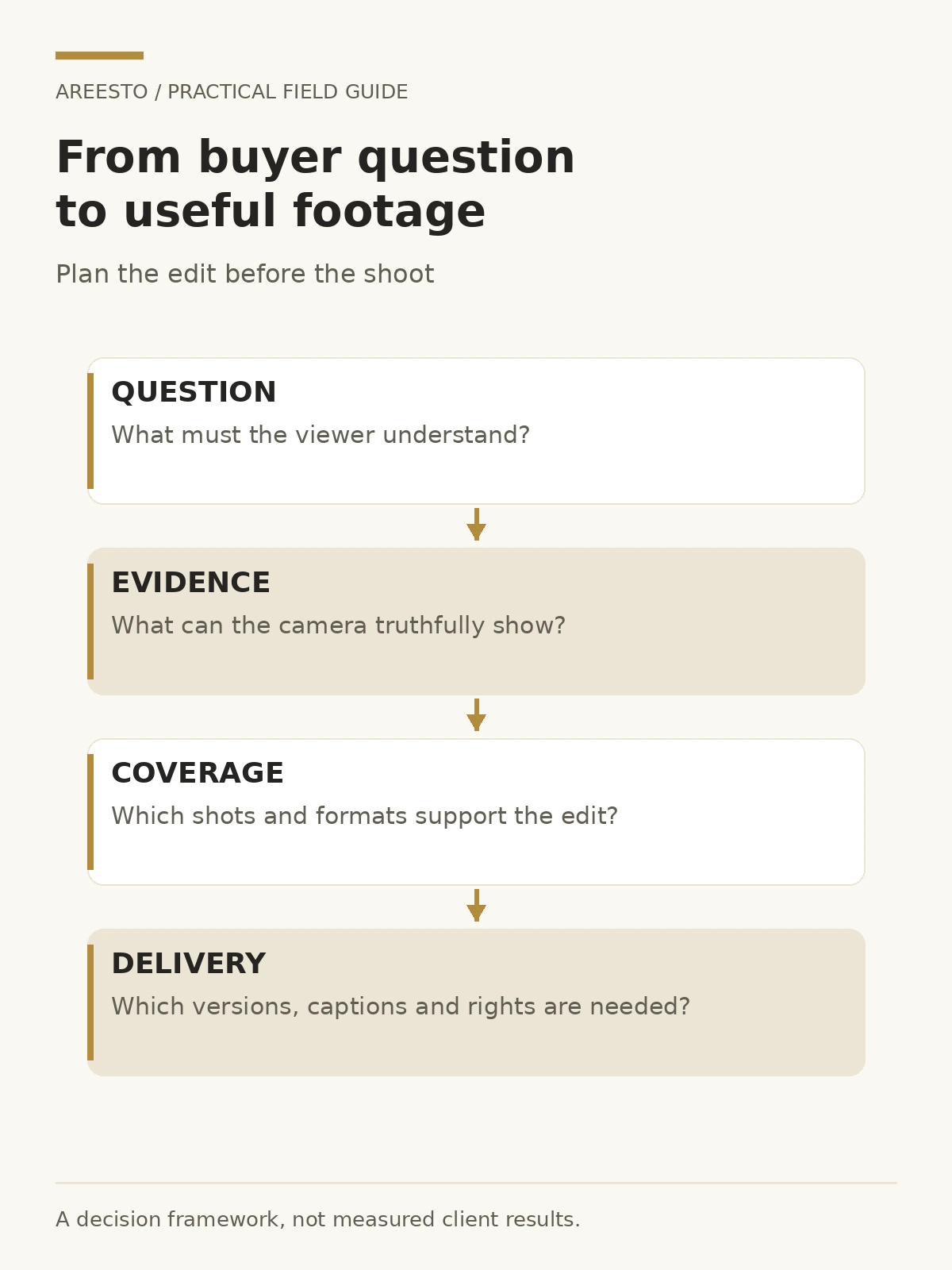
Map each video to a customer question and a next step
Start with the viewing situation. Is someone discovering the business, evaluating a service, learning how something works or preparing to contact the team? These moments need different explanations. A general introduction cannot automatically serve as a detailed demonstration or a focused advertising asset.
Write one main question beside each proposed deliverable. What would the viewer need to understand by the end? Identify the most relevant next step, such as reading service information or requesting a scoping conversation. Avoid asking a short film to introduce the entire company, explain every product and resolve every objection.
Make the evidence requirement explicit. If the message concerns a process, identify the real steps the camera can show. If it concerns expertise, decide which approved explanation or demonstration supports it. Do not fill a gap in evidence with dramatic footage that implies a capability the business does not have.
Use that map to brief video production for your UAE brand. The production team can then challenge missing coverage before the shoot instead of discovering it in the edit.
| Viewing job | Content requirement | Acceptance check |
|---|---|---|
| Understand the offer | Clear explanation and relevant proof | Viewer can describe the actual service |
| Evaluate a process | Approved steps and truthful demonstration | No important stage is implied incorrectly |
| Respond to a campaign | Focused proposition and matching destination | Next step agrees with the message |
| Reuse a clip | Self-contained meaning and agreed rights | It remains accurate outside the longer film |
Plan languages, speakers and claims before the shoot
Agree which deliverables require English, Arabic or both. Decide whether the plan uses separate spoken versions, subtitles, voice-over or different edits. These choices affect scripting, recording, pacing and review. Adding another language after picture approval can change more than the text on screen.
Choose speakers for their ability to explain the subject accurately and comfortably, not only their job title. Give them an approved message outline and enough preparation to avoid improvising unsupported claims. If a speaker changes a technical statement during recording, flag it for review instead of assuming the confident delivery makes it correct.
List statements that require evidence or specialist approval. Product capabilities, comparative claims, regulated information and client references should not be invented to make a script more dramatic. Establish who approves the final words in each language. A general brand review is not a substitute for a competent review of specialist claims.
Plan pronunciation, terminology and name spellings. Keep an approved record for the editor and caption reviewer. If a phrase does not carry naturally into another language, adapt the expression while preserving its truthful meaning. Do not resolve a translation problem by quietly changing the promise.
Capture reusable coverage without promising infinite versions
Turn the message map into a shot list. For each shot, record its purpose, required subject, relevant action and the edit it supports. Distinguish essential evidence from atmospheric material. Beautiful surroundings cannot replace the close-up that explains how a customer uses the product.
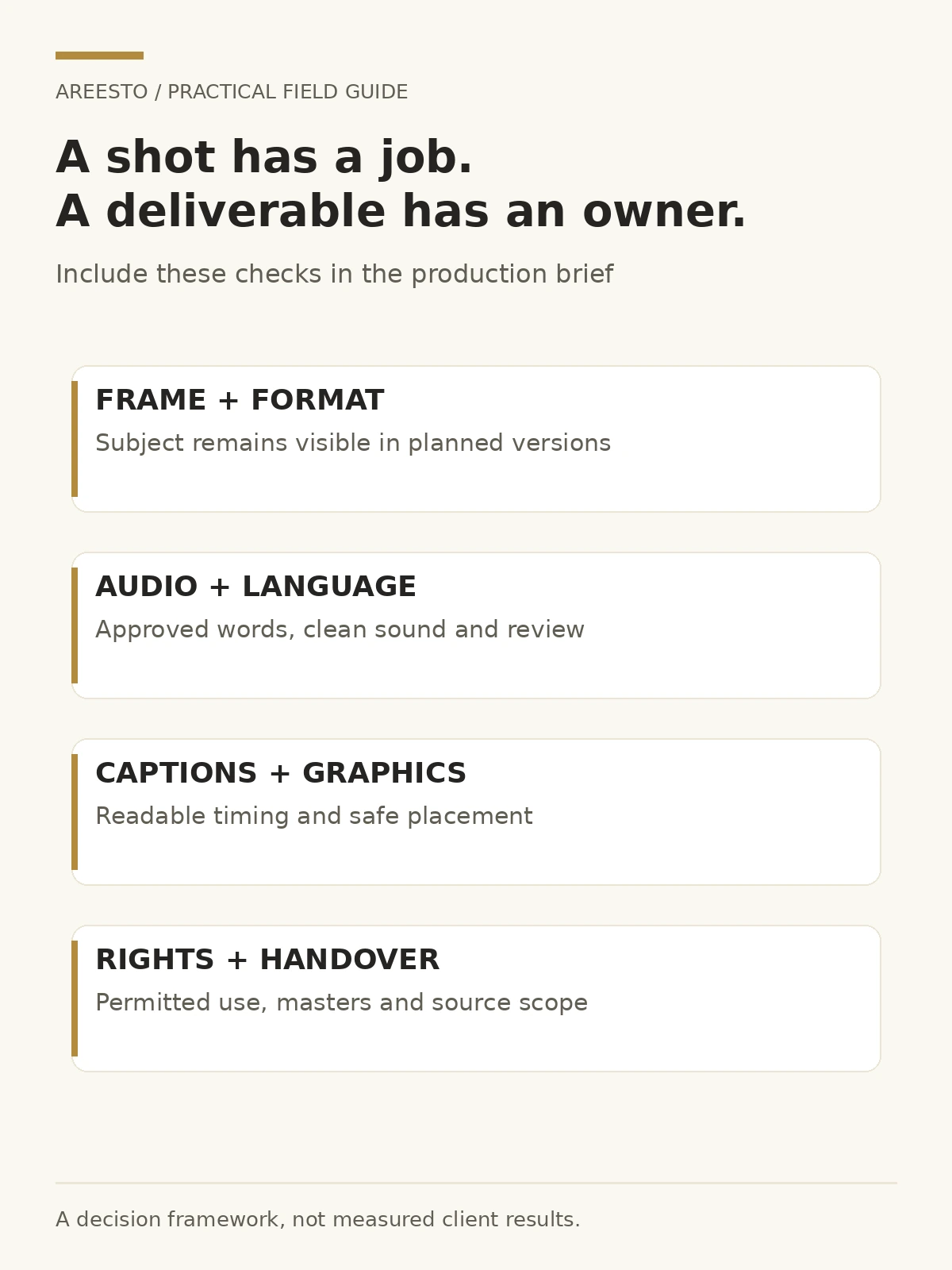
Plan the intended aspect ratios and compositions. A landscape interview may not crop into a useful portrait version if the speaker, demonstration and graphic area compete for the same space. Ask the production team which framing options or separate takes are needed. Reuse is a planning opportunity, not a guarantee that every future format can be extracted from one frame.
Capture the transitions and detail needed to tell the story honestly: an action beginning and ending, a clear demonstration view or a relevant environment. Keep continuity with what was actually filmed. An edit should not imply that unrelated scenes are evidence of a specific client project or operating process.
Record clean sound where speech matters and agree how background noise will be managed. If the essential explanation is inaudible, an attractive picture does not rescue it. Leave appropriate time for meaningful coverage rather than filling the entire schedule with location changes.

Specify captions, permissions and edit responsibilities
Captions should be planned as content, not a decorative overlay. W3C’s caption guidance explains that useful captions include speech and the non-speech audio information needed to understand the content. It also warns that automatic captions need accuracy checking. A missing word can reverse the meaning of a claim.
Distinguish same-language captions from translated subtitles in the brief, while recognising that terminology varies. Agree whether deliverables need separate timed files, embedded text or both, and check them in the intended player. Review timing, line breaks and placement so important visuals and interface controls are not obscured.
Confirm permitted use of locations, people, artwork, music and other third-party material through the appropriate approval process. Record where and how the finished content may be used. Do not assume that access to a location grants every permission or that a music track can be used in every advertising context. Obtain suitable specialist advice for rights and contractual questions.
Define the approval route. Name the person consolidating feedback, the reviewers responsible for factual and language accuracy and the stage at which structural changes need a new decision. The aim is not to eliminate creative judgement; it is to prevent conflicting instructions and unreviewed claims from reaching release.
Agree asset handover and run a realistic release check
List the final files in the proposal: named edits, formats, language versions, captions, thumbnails or other agreed assets. Clarify whether raw footage, audio stems or editable project files are included. Their delivery, rights and technical dependencies should be explicit rather than assumed.
Use descriptive version names and keep the approved master separate from drafts. Record restrictions and review triggers with the asset library. A product change, withdrawn claim or expired permission may make an otherwise polished clip unsuitable for reuse.
Watch the intended releases in their actual viewing context before approval. Check speech, silent understanding where relevant, caption accuracy, readable on-screen text and the destination of any call to action. Verify portrait and landscape editions separately. A working master does not prove every derivative export is correct.
Finally, ask someone unfamiliar with the project to explain the main message and next step. If they need a producer beside them to understand it, the film may still depend on missing context. Fix that before release rather than adding a confident caption to an unclear story.
Bring a deliverable map, approved claims and a preliminary application list to your next brand-video production discussion. It is a more useful starting point than asking for a beautiful film and hoping its purpose becomes clear later.
Frequently asked questions
Can one shoot produce every format we might need?
Not automatically. Agree the actual deliverables and plan framing, language and coverage for them. Some formats need separate takes or compositions.
Should subtitles be added after editing?
Plan them before production, even if they are applied later. Language length, timing and placement can affect the shot plan and the edit.
Are automatic captions ready for release?
They can be a starting point, but need accuracy review. Check names, technical words, timing and non-speech information that matters to understanding.
Does a production package always include raw footage?
No. Specify the handover, rights, file types and dependencies in the agreement. Do not infer ownership or delivery terms from a package label.