
Company Profile or Sales Deck? What UAE Buyers Need From Each

Imagine a beautifully designed document landing in a buyer’s inbox. The cover is impressive. Inside, a sequence of large claims makes perfect sense to the salesperson who normally explains them. Alone at a desk, the buyer cannot tell which service fits the brief, what the company can substantiate or what to do next.
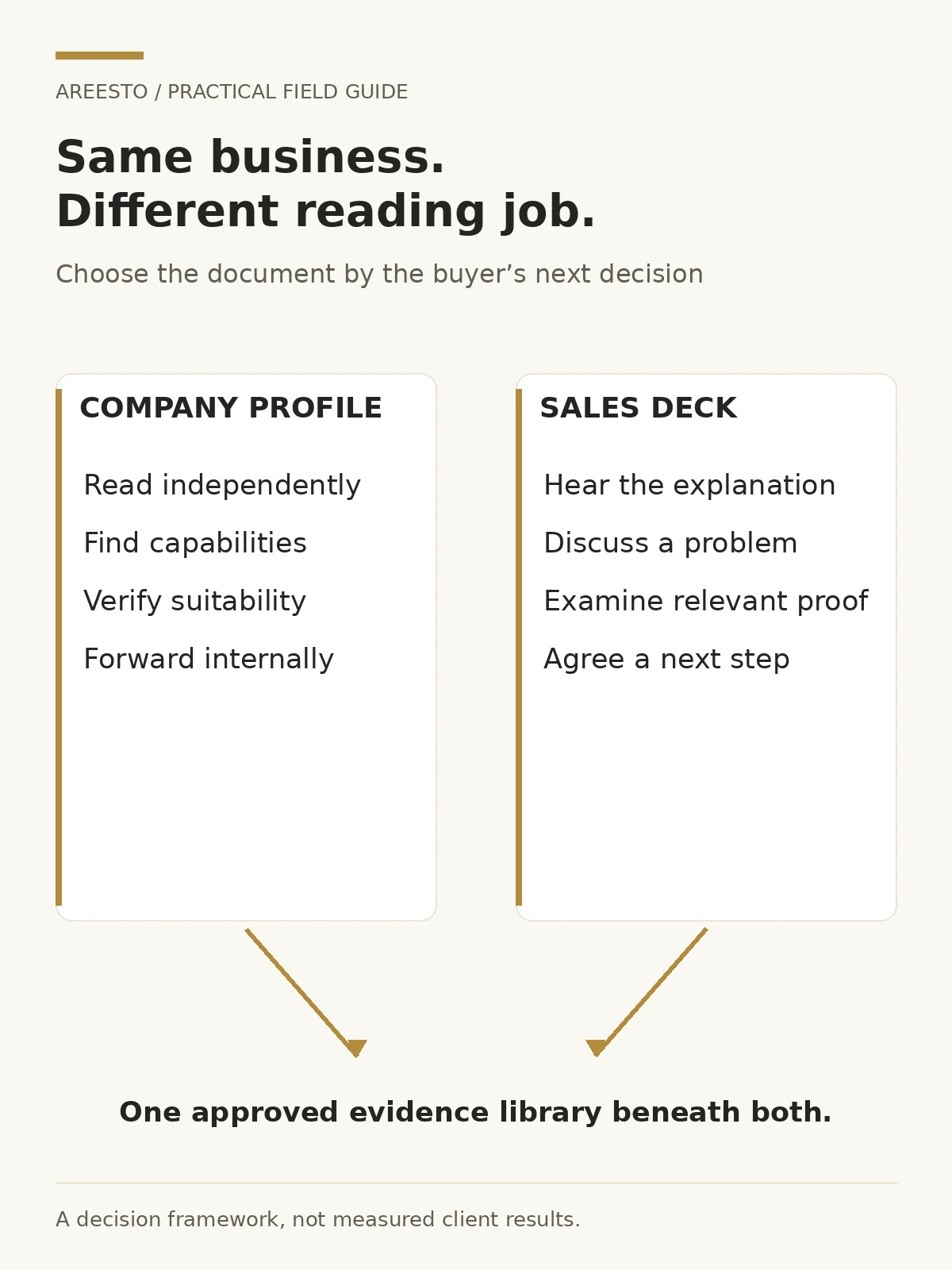
A company profile helps someone assess a business independently. A sales deck helps a presenter guide a particular buying conversation. They can share an evidence library and a visual system, but they should not share an identical structure by default. For a UAE business preparing English and Arabic material, deciding the reading job first makes the design brief much sharper.
Match the document to the moment in the buying journey
A company profile may be forwarded to a colleague who has never spoken to your team. It therefore needs enough context to stand alone: what the business does, which audiences it serves, the relevant capabilities and the next contact route. It should make essential information easy to retrieve rather than requiring a dramatic reveal.
A sales deck operates differently. A presenter can ask questions, choose examples and adjust the conversation. The deck should support that dialogue rather than display everything the company knows. Its order might begin with the buyer’s situation, move through a relevant approach and finish with a decision or next step.
Procurement material is another related but distinct requirement. If a buyer asks for specific company information or supporting documents, respond to that request accurately. A brand narrative is not a substitute for a requested evidence pack. Equally, do not put private or commercially sensitive documents in a widely shared marketing PDF simply because procurement might request them later.
Before briefing a designer, finish this sentence: “After using this document, this reader should be able to…” If the answer combines independent screening, a live pitch and detailed compliance review, consider separate outputs with a shared foundation. Areesto’s design services in Dubai can be briefed around those specific reading tasks rather than an arbitrary page count.
| Situation | Primary format | What the reader needs |
|---|---|---|
| Independent introduction | Company profile | Clear capabilities, relevant evidence and contact route |
| Guided discussion | Sales deck | A focused argument with room for questions |
| Specific buyer information request | Tailored response or evidence pack | Accurate answers to the requested criteria |
Build a buyer-led structure and an evidence hierarchy
Start a profile with orientation, not a long ceremonial introduction. Explain the business plainly, make the service categories understandable and help readers find what matters to them. History can be useful when it explains capability or continuity; it should not delay the answer to “Can this company help us?”
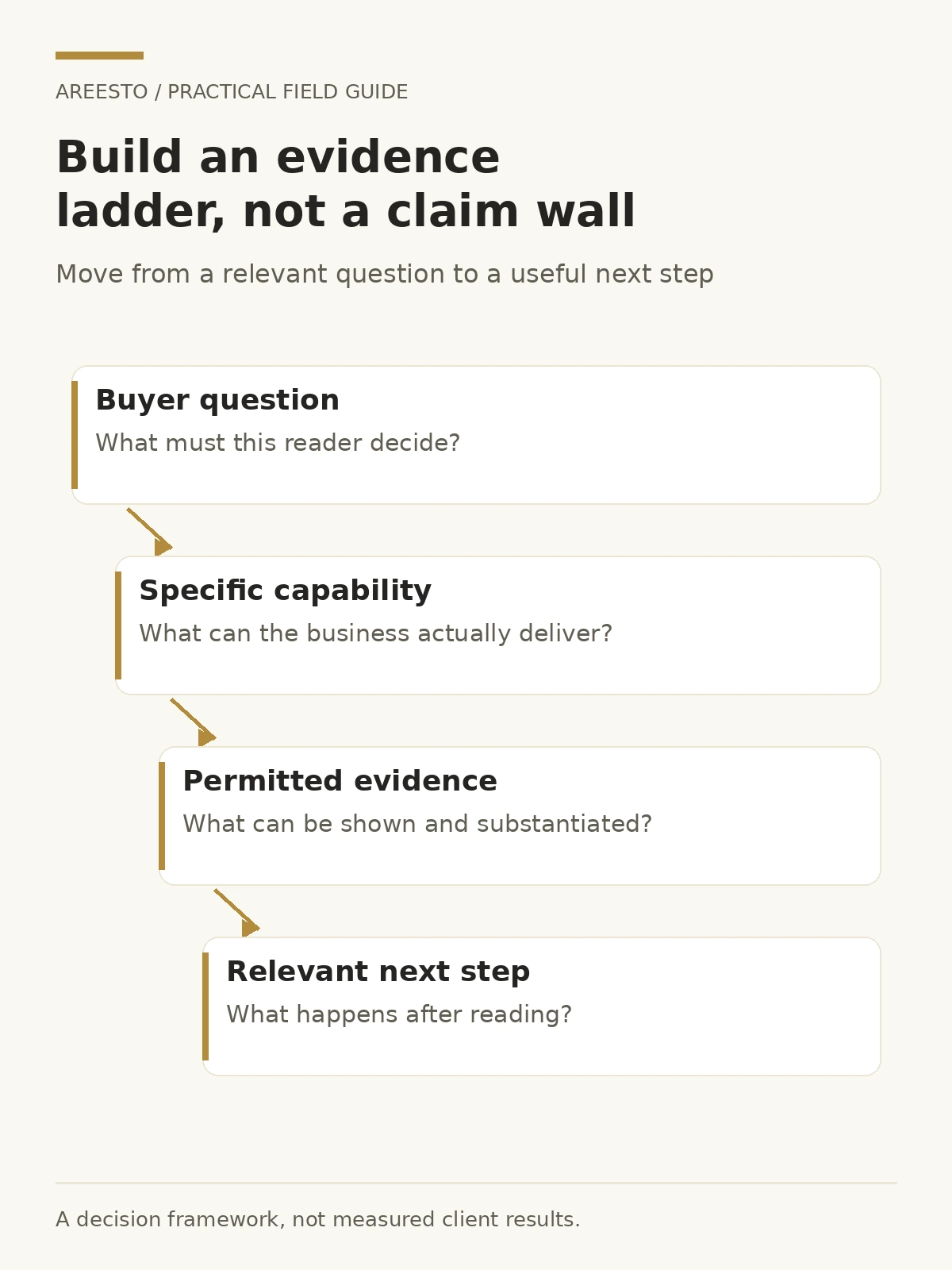
For each major claim, ask what evidence you are allowed to show. A permitted project example can explain scope and the work delivered. A process description can show how an assignment is handled. A named qualification should appear only if it is genuine, current and relevant. Avoid turning aspirations into accomplishments through confident typography.
Do not add client logos without permission or use a confidential assignment as an anonymous success story with invented results. If permission or usable evidence is unavailable, narrow the claim. Explain the capability, the method and what would be established during scoping. An honest limitation is stronger than a polished claim nobody can defend.
A sales deck needs the same discipline but a more selective sequence. Choose the proof relevant to this buyer’s question instead of including a generic gallery. Keep fuller evidence available in an appendix or follow-up material, with appropriate permissions. The presenter should know which claims the available evidence actually supports.
Use a simple editorial test: every spread or slide must answer a reader question, substantiate a claim or support a decision. If a page exists only because there is space for another stock image, remove it or give it a clear purpose.
Write for scanning without making the business sound empty
Specific headings do more work than slogans. “Services for multi-location operators” tells a reader where to look; “Possibilities without limits” does not. Use descriptive headings, short introductions and a consistent hierarchy so someone can skim first and read more deeply where necessary.
In a profile, write complete enough explanations for independent reading. In a presented deck, use concise on-slide language and put the fuller explanation in presenter notes where helpful. If the deck will also circulate without a presenter, create a reading edition rather than assuming sparse slides will explain themselves.
For a digital companion page, use real semantic headings, not merely large bold text. W3C’s heading guidance explains how meaningful structure supports navigation, including assistive navigation. This does not mean a PDF exported from a design application automatically becomes accessible; the exported document needs its own checks.
Make the call to action proportionate to the reading stage. A general profile might invite a relevant scoping conversation. A sales meeting might end by agreeing what information is needed to prepare a proposal. Avoid several competing buttons, ambiguous contacts or a final slide that says only “Thank you”.

Plan bilingual editions and mobile reading before layout approval
Decide whether your readers need separate language editions, a bilingual document or a concise shared introduction with more detailed supporting material. The right answer depends on actual use, not an assumption that every page must always carry both languages. Separate editions also need a process for keeping shared facts synchronised.
Have language reviewers work with the real layout. A phrase that is concise in English may occupy a different shape in Arabic, and titles, names and mixed-direction contact information need particular attention. Establish approved terminology for services and roles. Let language specialists review meaning, not merely the appearance of letterforms.
Do not solve a crowded bilingual page by shrinking both languages until neither is comfortable to read. Simplify the content, change the layout or split the information. Check the actual file on a phone: can someone read it without constant zooming, understand headings and use contact links? A desktop artboard is not evidence of a successful mobile reading experience.
Where a web version is appropriate, it can offer a more flexible reading path than a fixed page. Keep its facts aligned with the document and test the actual navigation. The web version should not become a second, neglected source of company information.
Build reusable masters and a controlled handover
Create one approved evidence library before producing variations. It can hold service descriptions, permitted images, approved project summaries, team information that may be shared and current contact details. Record who owns each item and whether there are usage restrictions. Not every source file should be distributed to every salesperson.
Separate reusable layouts from approved content. A template helps the team work consistently, but unrestricted editing can quickly create unofficial claims. Define which fields users may change, which sections require approval and where the current master lives. Agree software and font requirements before handover so the files are genuinely usable.
Run a practical release test. Ask someone outside the project to find a relevant capability, explain the business in their own words and locate the next step. Ask the sales team to present the deck using a real conversation outline. Record confusion rather than coaching people through it; the difficulty may reveal a content problem, not a reluctant reader.
Finally, set a review trigger. A changed service, withdrawn example or new contact owner should prompt a targeted update. Retire outdated versions in shared folders and make the approved edition easy to recognise. If you need a profile and a deck, brief a coordinated sales-collateral design system rather than two disconnected files.
Frequently asked questions
Can a company profile also be used as a sales deck?
Some information can be reused, but the structure usually needs adaptation. Independent readers need context that a presenter might otherwise supply, while a sales conversation benefits from a more selective sequence.
How long should a company profile be?
Long enough to answer the intended reader’s questions without repetition. Define the content and evidence first; do not use a page count as a substitute for a useful brief.
Should a UAE company profile be bilingual?
Base the choice on the readers and where the document will be used. Separate English and Arabic editions or a bilingual layout may be appropriate, but each needs language review and an update owner.
What should be handed over besides the final PDF?
Agree editable masters, permitted assets, font and software requirements, presentation notes where relevant, and rules for updates. The exact package should match who will maintain the documents.