
One Company, Several Brands: A Practical Brand Architecture Guide for UAE Groups

Imagine a group website whose home page looks coherent until someone tries to explain it. One division uses the parent name, another has a separate identity and a third appears to be a product, a subsidiary and a campaign at the same time. Customers are not looking at the ownership chart. They are trying to understand what belongs together and whom to trust.
Brand architecture defines the relationships between a parent brand, business units, offers and other customer-facing brands. A useful architecture makes those relationships understandable to buyers and manageable for the business. It is not simply a new family of logos, and it is not the same thing as the group’s legal structure.
Map the portfolio as customers encounter it
Begin with an inventory of names in use: parent, divisions, products, service lines, programmes and legacy brands. Record where each appears and what customers believe it represents. The name on a contract, the name on a storefront and the name in a search result may not be identical. That is a relationship to explain, not necessarily an error to erase.
Add the buying audience, the underlying offer, the owner of the customer relationship and any known constraints. Note names that exist only internally and names customers actively ask for. Do not promote every department into a brand because it occupies a box on an organisation chart.
In a UAE group, language adds another layer. List approved Arabic and English names, transliterations and abbreviations. Record where different versions already appear. This is an inventory of current reality, not permission to improvise a legal name or assume an attractive translation is available for use.
Then mark the actual confusion. Are buyers unable to connect related services? Does a specialist offer disappear beneath a broad parent description? Do staff describe the same relationship differently? A useful architecture project starts with these observable problems rather than a preference for tidy diagrams.
Compare three common relationship models without choosing by fashion
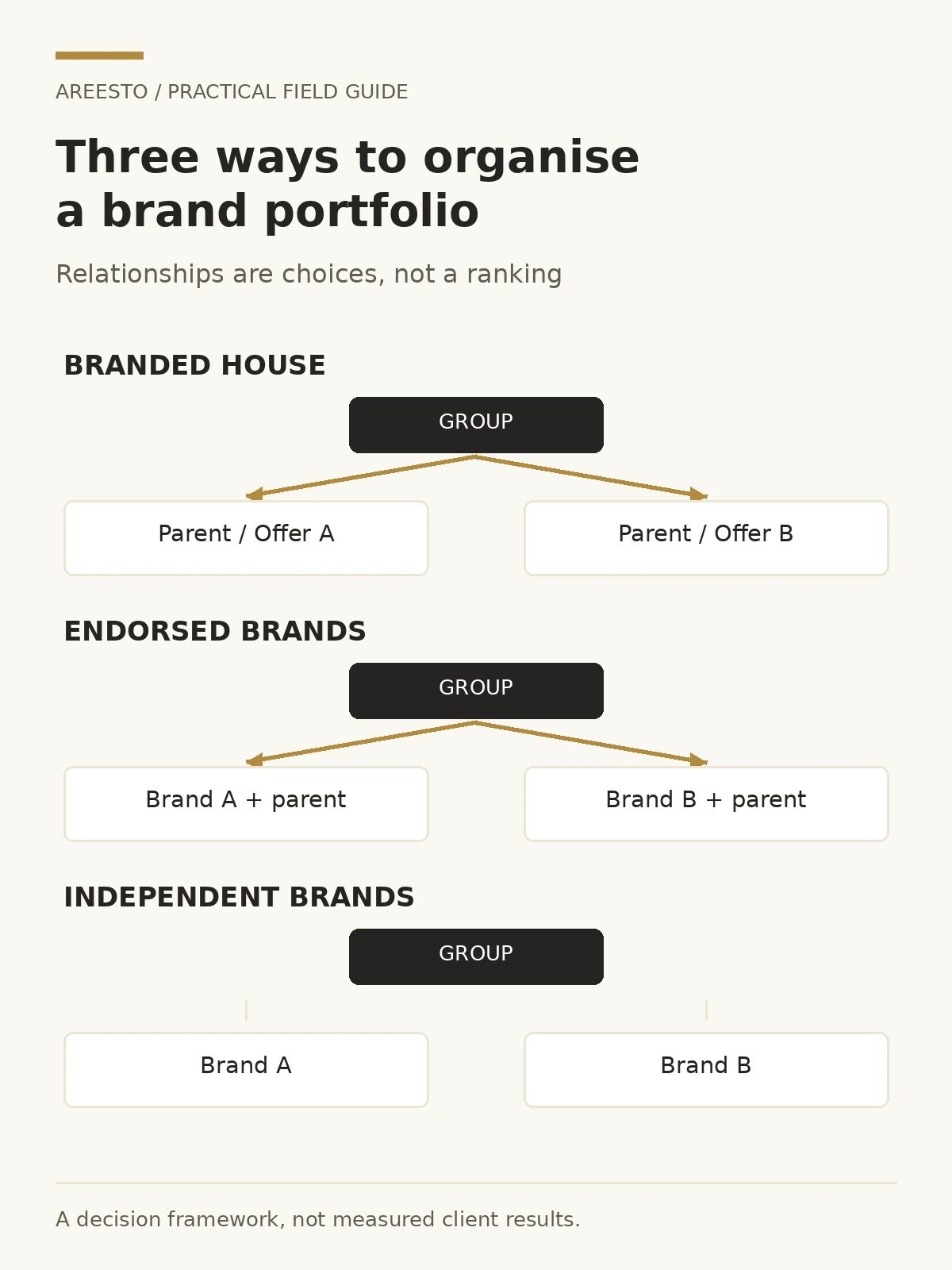
In a branded-house approach, the parent identity leads across related offers. This can make the relationship immediately visible, but it asks the parent to carry a credible promise across those offers. A shared name cannot resolve a mismatch between what different businesses actually deliver.
Endorsed brands retain a distinct identity while making the parent relationship visible. The endorsement must be understandable and consistently applied. A tiny parent mark that no one can interpret may add visual clutter without adding useful meaning.
Independent customer-facing brands place less emphasis on the common parent. That may be appropriate when audiences, propositions or established recognition differ. It also creates more systems to maintain. Separate identities do not eliminate shared ownership or make commercial and reputational issues disappear.
| Relationship | Potential fit | Main question to resolve |
|---|---|---|
| Branded house | Related offers with a credible shared promise | Can the parent meaning stretch without becoming vague? |
| Endorsed brands | Distinct offers helped by a visible parent connection | What reassurance does the endorsement actually add? |
| Independent brands | Offers needing distinct customer-facing identities | Can the business maintain them and explain ownership where needed? |
Mixed portfolios can be sensible. The goal is not to force every acquisition or future offer into one visual pattern. It is to establish a rationale that teams can apply to the next decision. Areesto’s brand strategy work in Dubai can be scoped around those portfolio choices before redesign begins.
Test the choice against buyers, credibility and operating capacity
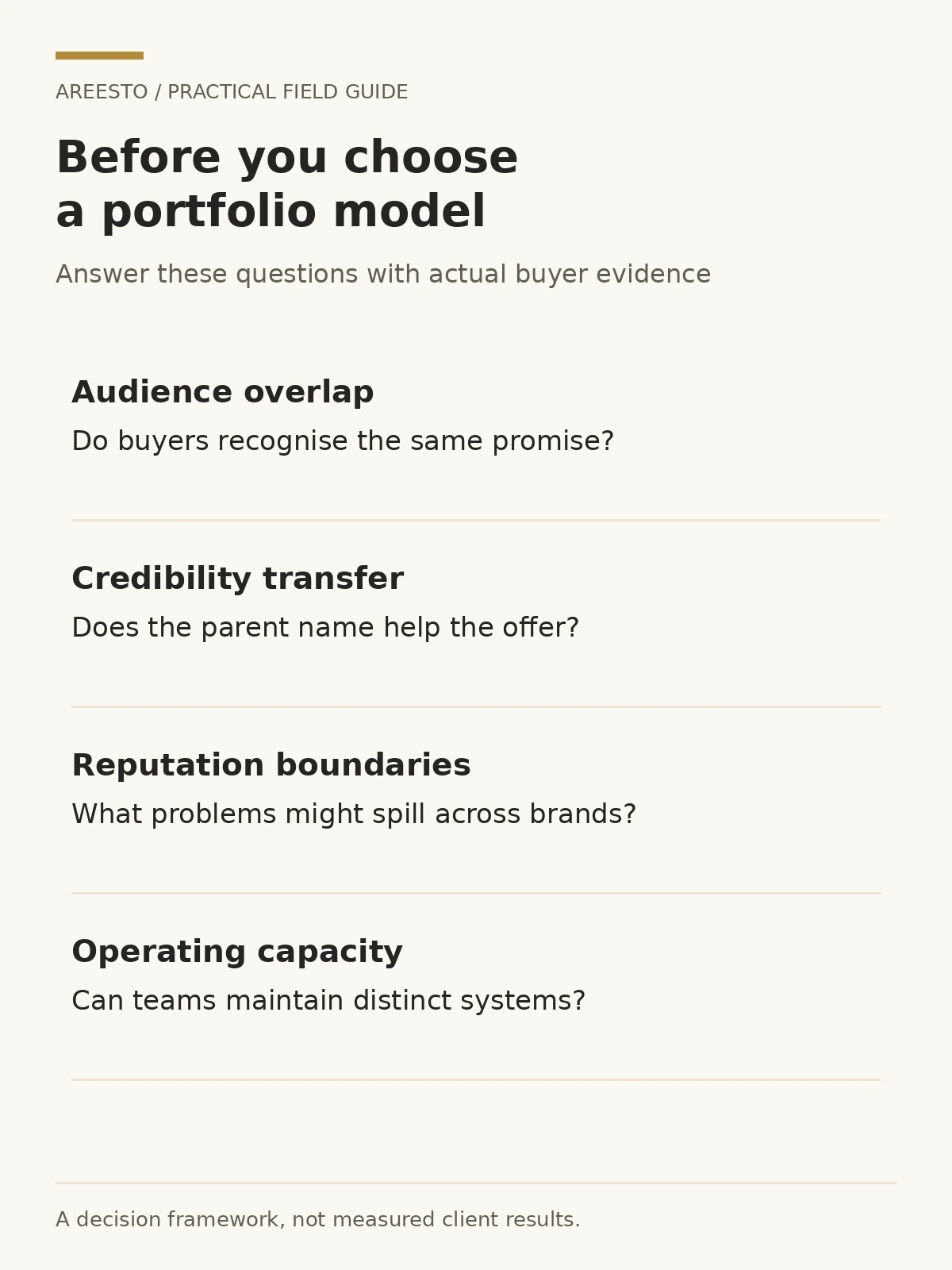
Start with audience overlap. Do the same people buy the offers, and do they expect a similar standard or experience? Shared ownership alone is not evidence that the same customer promise is useful. Equally, different products do not automatically require separate brands if buyers recognise a meaningful common relationship.
Next, examine credibility transfer. Ask what the parent name helps someone understand and whether there is evidence for that interpretation. Customer interviews can reveal associations and confusion; they do not establish market-wide prevalence by themselves. Keep observed findings separate from assumptions management would like to be true.
Consider reputation boundaries honestly. Connecting names may make relationships clearer, but it can also connect customer expectations. Separating names does not guarantee isolation from negative events. The architecture should reflect the experience the group can deliver rather than imply protective effects it cannot promise.
Finally, check operating capacity. Distinct brands need clear owners, maintained assets, useful messaging and coordinated changes. A portfolio that looks strategic on a presentation can become expensive organisational ambiguity if nobody can keep it current. Ask who will decide whether the next offer receives a descriptor, an endorsement or a separate identity.
Test proposed relationships in real examples: a website header, an introduction in a proposal, a customer-service reply and a directory listing. Ask readers to explain who provides the offer and how it relates to the group. Their explanation is more useful than asking whether they like the diagram.

Write naming and endorsement rules teams can use
Architecture becomes practical through a small set of explicit rules. Define what qualifies as a new customer-facing brand, who approves it and which naming pattern applies. Explain when the parent name is prominent, when it is an endorsement and when a legal relationship is communicated elsewhere through appropriate wording.
Create a name record for each approved entity or offer. Include its purpose, audience, English and Arabic forms, permitted abbreviations, relationship statement and owner. Avoid allowing different teams to invent shorthand that changes the relationship. A service descriptor should not quietly turn into a new brand merely because it receives its own logo.
Creative naming and legal protection are separate questions. WIPO’s trademark overview explains the distinguishing function of trademarks; it does not clear a proposed name for a UAE business. Seek appropriate specialist advice for availability, registration and contractual questions before committing to use. A design sign-off is not a legal clearance.
Endorsements also need language rules. “Part of”, “by” and a visual parent badge can imply different relationships to a reader. Choose wording that accurately describes the relationship and have it reviewed in both languages. Specify acceptable layouts rather than expecting a supplier to guess the hierarchy each time.
Plan migration as a customer explanation, not a logo replacement
Once a direction is approved, inventory the affected touchpoints. Include websites, proposals, profiles, signage, email signatures, documents and partner listings. Record the owner, the current version, the intended change and any dependencies. Keep legal names and required disclosures accurate while changing customer-facing presentation.
Decide what continuity customers need to understand. If an established name changes, explain what remains the same and what genuinely changes. Do not claim continuity of services, contracts or teams unless that is accurate. Prepare staff language before customers start asking questions.
For changed web addresses, plan a proper technical migration rather than replacing links at random. Google’s guidance on site moves with URL changes covers matters such as URL mapping and redirects. It does not promise unchanged rankings. Keep useful URLs where possible and involve the responsible web team.
Set an exception process after launch. Acquisitions, partnerships and new offers may need a different relationship from the default. Record why an exception exists so the portfolio does not drift back into unexplained inconsistency. A usable outcome is a decision rule, a maintained inventory and a rollout plan—not just a more elegant chart.
If your group is difficult to explain in one clear paragraph, start by mapping the relationships. Discuss a portfolio-focused brand strategy brief before commissioning another isolated identity.
Frequently asked questions
Is brand architecture the same as an organisation chart?
No. An organisation chart describes internal structure. Brand architecture describes how customer-facing names and offers relate. It should remain accurate about ownership without reproducing every internal department.
Does every subsidiary need a separate brand?
No. The choice depends on its audience, proposition, existing recognition, parent credibility and the business’s ability to maintain a distinct identity.
Can a group use several architecture models?
Yes. A mixed portfolio can be appropriate when relationships differ. Document the rationale and approval rules so the mixture remains understandable rather than accidental.
Should architecture be decided before new logos?
Usually the relationship decision should come first. It determines naming, hierarchy and endorsement requirements that an isolated logo project cannot resolve on its own.