
Property Brochure or Investment Pitch? Design for Different Dubai Real Estate Buyers

The same property can represent very different decisions. Someone considering a home may want to understand the rooms, everyday access and what is actually included. Someone evaluating an investment may need the basis for assumptions, ongoing costs and what remains uncertain. A beautiful brochure can leave either reader with the wrong information.
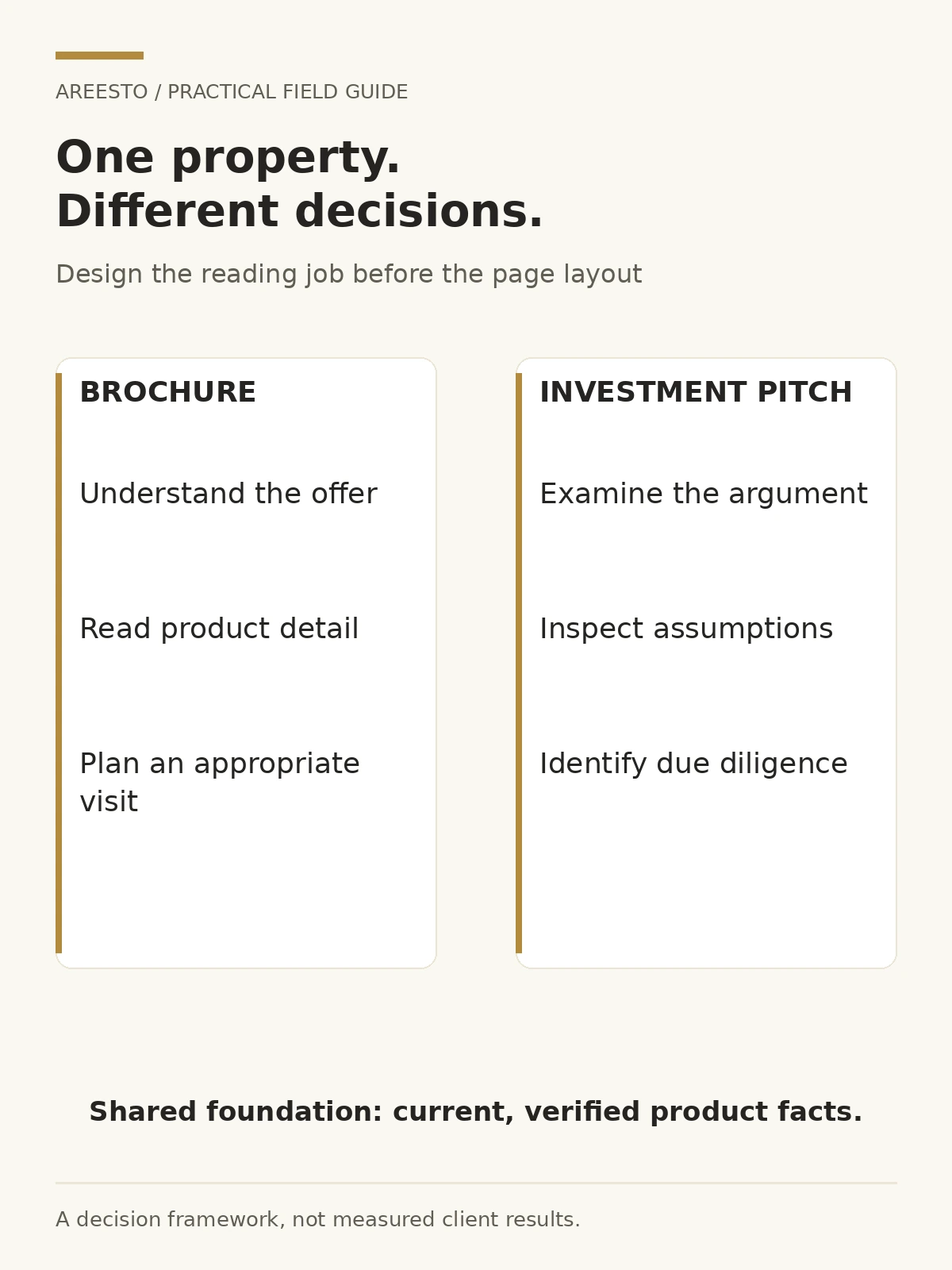
A property brochure introduces and explains the property. An investment pitch presents a decision argument, with its evidence, assumptions and limitations made visible. They can share verified source material and visual language, but should not be treated as interchangeable files or as substitutes for independent due diligence.
Separate the reading jobs before designing the document
Write down what each audience needs to decide next. A prospective occupier might be comparing layouts or preparing a viewing. An investment reader might be evaluating whether a proposition warrants further professional review. Avoid reducing either audience to a stereotype: an owner-occupier can ask financial questions, and an investor can care deeply about the usability of the property.
Define the document’s role in that decision. An introductory brochure should help a reader identify the offer and find relevant detail. A presented pitch can guide a more selective conversation. A formal information request may need a separate evidence pack rather than a longer lifestyle story.
Do not confuse persuasion with suitability advice. A marketing document should accurately describe what is offered and explain its information basis. It should not decide that the property suits every reader or imply that independent professional advice is unnecessary.
Brief real-estate marketing in Dubai around the reader and next decision, not only the number of pages or a preferred visual mood. That gives the designer a useful hierarchy to work with.
| Information need | Brochure emphasis | Investment-pitch emphasis |
|---|---|---|
| Understand the property | Layout, specification and relevant context | Product definition before financial discussion |
| Evaluate a claim | Source-backed product and location detail | Evidence, assumptions and uncertainty |
| Know what can change | Current version and accurate qualifications | Sensitivity to costs, timing and conditions |
| Continue the process | Viewing or appropriate enquiry | Further verification and relevant advice |
Build a verified location and product record
Collect the approved project or property name, the specific unit or product being discussed, source plans, specifications and current commercial information from authorised owners. Give each fact a source and a review responsibility. A polished layout should not make an unverified statement appear more certain.
Distinguish location from travel-time claims. A simple map can orient a reader, while a promised journey duration depends on conditions and a defensible measurement basis. If the source is unavailable or the claim cannot be supported, use accurate descriptive context rather than inventing a convenient number.
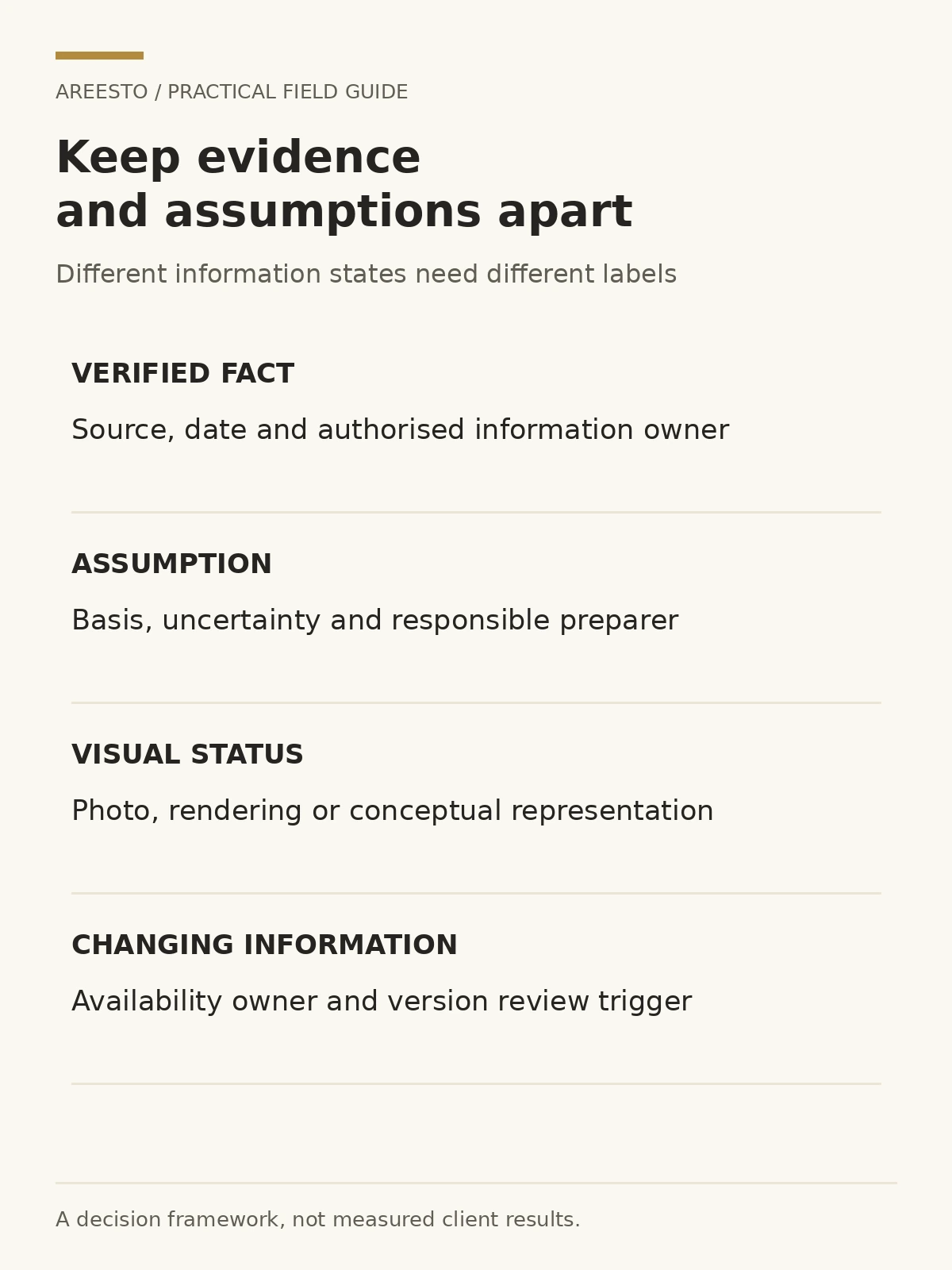
Keep photographs, architectural illustrations and conceptual images clearly distinguished. An attractive rendering is not evidence of current construction, a specific view or the exact finish of an available unit. Captions and surrounding text should explain the relevant status without relying on a tiny disclaimer to correct an otherwise misleading impression.
Dubai Land Department’s Project Status Enquiry provides an official route to project completion information and details. It is a verification resource, not an endorsement of a marketing pitch or a guarantee of a project’s future performance. Use appropriate current sources for the particular claim and property.
If a requested detail is unavailable, mark it for confirmation and name the responsible source. Do not substitute a nearby unit’s specification or a general project image merely to make the document feel complete.
Keep investment assumptions separate from verified facts
If financial material is included, state what is observed and what is an assumption. An existing contractual amount, an estimate and a projected scenario have different evidential status. Do not present them with identical typography and leave the reader to discover the distinction in an appendix.
Explain the basis and limits of any model prepared by the responsible qualified team. Relevant costs, timing, vacancy assumptions or other conditions can materially affect an interpretation. Do not omit an important input simply because the resulting headline would be less attractive.
A scenario is not a promised result. This article supplies no return forecast, price expectation or availability claim. A design team should not create one to complete an infographic, nor should it convert an unsupported sales assertion into a chart that looks like research.
Use a source note beside the claim, with an appropriate date and owner. Where the information is uncertain, say so plainly. If the argument needs specialist financial, legal or property advice, identify that dependency rather than allowing visual confidence to stand in for it.

Make bilingual plans and comparisons readable
Keep the hierarchy stable across English and Arabic editions: property identity, key features, important qualifications and next action should remain understandable. The layouts may need adaptation, but the underlying facts should not drift between languages.
Do not shrink a detailed plan until its labels are unreadable on a phone. Provide a suitable larger view or a separate accessible explanation where needed, and ensure the viewing route is obvious. Labels should distinguish the relevant plan or unit without implying that every layout is interchangeable.
Review numerals, measurements and mixed-direction fragments in the working file. W3C’s bidirectional text guidance explains why embedded phrases and numbers need deliberate handling. A language proofreader and a production reviewer have complementary roles; neither should assume the other has tested the final export.
Comparisons need matching definitions. If one document describes a different specification, product stage or information date, make that difference explicit. A comparison table is useful only when its labels help readers understand what is genuinely comparable.
Connect availability, revisions and enquiries
Assign an owner to approve current availability and commercial statements before release. The designer should not infer a live offer from an old working deck. Record which version the sales team may circulate and how outdated copies are retired.
Check the enquiry destination as carefully as the cover. Does the receiving team know which property, language and document version the reader saw? Can it clarify what is current without contradicting the document? Avoid a route that sends a specific enquiry into a generic queue without context.
Keep a change register for specification updates, amended information and withdrawn material. Where a document is already in circulation, decide how the team will explain a material change. Quietly replacing a shared file does not ensure every reader has the current version.
Before approving design, ask a suitable reader to find the property definition, locate a supporting source and explain the next step. If those tasks are difficult, fix the hierarchy rather than adding another lifestyle spread. Discuss buyer-specific property collateral once the information responsibilities are clear.
Frequently asked questions
Can one property brochure serve every buyer?
It can share core information, but different decisions may need different depth and structure. Adapt the document without changing or overstating the underlying facts.
Should an investment pitch include projected returns?
Only where the responsible qualified team has a defensible basis and clearly explains assumptions and limitations. Design must not invent or imply guaranteed returns.
Are architectural renders evidence of current condition?
No. Identify visual status appropriately and support current-condition or specification claims with suitable verified information.
Who should approve changing property information?
Name authorised owners for product, commercial and relevant specialist information. Keep version control and sales handoff connected to those approvals.