
“The Hardest Thing Is to Earn Money”: How Dubai Design Studios Should Brand the Practice, Not Just the Rooms
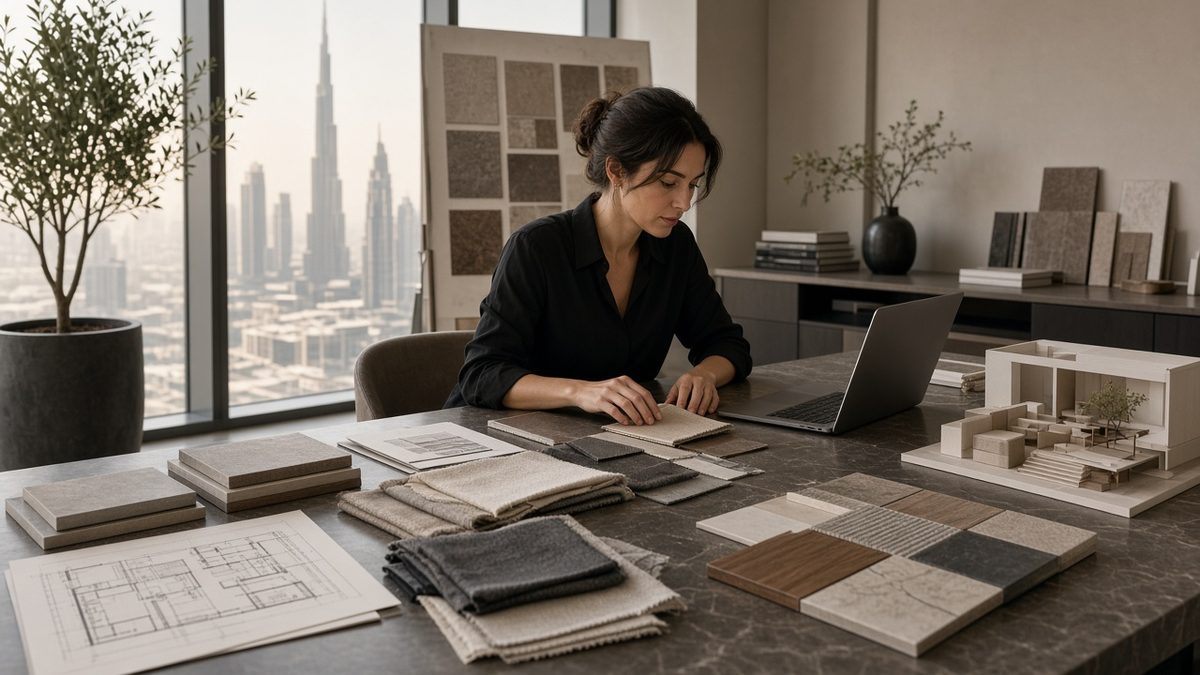
Design press loves a candid headline. This month Dezeen quoted the duo behind Swedish Girls saying that the hardest thing is to earn money. It is the kind of sentence many studio founders in Dubai could say out loud: the work is admired, the Instagram grid is full, and yet the practice itself feels harder to run than the projects.
That gap is a branding problem as much as a business one. A portfolio proves that a studio can make beautiful rooms. It does not explain why a client should choose this studio, wait for it, or pay for its judgement. For interior design marketing in Dubai, the stronger move is to brand the practice, not only the rooms. This piece sits alongside why a studio needs a spatial identity of its own and how work that belongs to its place can set a studio apart.

A Portfolio Is Evidence, Not a Position
Walk through the websites of ten design studios and the pattern is familiar: a hero image of a marble-clad lobby, a menu with Residential, Hospitality and Commercial, and a short paragraph about passion for detail. Each studio may be excellent. Together they blur into one voice, and the client is left comparing photographs.
A position answers a different question: what is this studio for? It may be a studio that designs homes for families who entertain, or one that specialises in compact apartments, or one that is known for calm, restrained hospitality interiors. The point is that the answer is specific enough for a client to repeat to a friend.
The questions that shape a practice brand
- Who do we most enjoy working for, and who do we quietly avoid?
- What do our best projects have in common besides their finish?
- What do we say no to, and why?
- How do we work with a client from first conversation to handover?
- What would a client miss if we were not on the project?
Name, Point of View and Process
Three pieces carry most of the weight in a practice brand. The first is the name. A studio name that is easy to say, spell and search for, in English and in Arabic, saves effort every time someone recommends it. The second is a point of view: a few clear beliefs about how spaces should feel and how clients should be treated. The third is a visible process, because clients pay more readily for a way of working they can understand.
Process is where many studios leave value on the table. Concept, design development, procurement, site supervision and handover are all skilled work, yet most websites show only the finished photograph. Explain the stages in plain language and clients begin to see that they are buying judgement, coordination and calm, not just a look.
Show the thinking, not only the result
Short case narratives help more than image-only galleries. A paragraph on the brief, the constraint that shaped the solution and what the client’s day feels like now gives a prospect something to relate to. Use only real projects and real permissions, and keep numbers and client details out unless the client has agreed to share them.
Brand the Studio the Way You Want to Be Paid
How a studio looks and speaks sets expectations about fees. A practice that presents itself as a quick decorating service will attract quick decorating budgets. A practice that presents itself as a considered design partner, with a clear scope, a thoughtful brief and a careful handover, invites a different conversation.
That does not require fancy language. It requires consistency across the proposal, the website, the first email and the studio itself. If a prospect’s first impression is a polished practice, the pricing conversation starts from a stronger place. We explore how that consistency extends into the physical space in our piece on spatial identity for interior studios.

Make proposals part of the brand
A proposal is often the most-read document a studio produces. Give it the same care as a project board: a clear structure, a short statement of the studio’s approach, the stages, what is included and what is not. Clients who understand the scope are less likely to argue about it later.
A Practical 60-Day Plan for a Studio Brand
- Weeks 1–2: write down the studio’s point of view, ideal client and three things it will not do
- Weeks 3–4: refresh the name, logo and website structure so they reflect that position
- Weeks 5–6: write a plain-language description of each project stage and add it to the site and proposals
- Weeks 7–8: rewrite two or three project stories around the brief, the constraint and the client’s experience

Frequently Asked Questions
Does a small studio really need a brand?
Every studio already has one, whether or not it is designed. A deliberate brand simply makes it easier for the right clients to find and trust you, and for you to say no to the wrong ones.
Should we show our prices?
Not necessarily. It helps more to explain what is included, how you work and what influences cost, so that prospective clients arrive with realistic expectations.
How do we avoid sounding like every other studio?
Replace generic phrases like passion for design with specific beliefs and examples. If a competitor could copy a sentence word for word, it is not yet part of your brand.
Build a Practice, Not Just a Portfolio
Rooms win attention. Practices win trust, referrals and sustainable fees. Studios in Dubai that brand the practice with the same care they give a hotel lobby or a villa will find the work easier to win, and the business easier to run.
Areesto is a Dubai-based branding and marketing agency working with interior design studios, fit-out specialists and furniture and décor businesses across the UAE and the GCC. To give your practice a clearer name, point of view and studio experience, email office@areesto.com or explore our interior design marketing services in Dubai.