
Lots of Enquiries, Few Sales? Diagnose Your UAE B2B Lead-Quality Problem

Imagine a campaign report that looks encouraging. Enquiries are arriving, the team is busy, and the cost per lead appears manageable. Then sales opens the discussion with a different story: wrong companies, vague requests, conversations that disappear. Both teams may be reporting honestly. They may simply be measuring different stages of the journey.
To diagnose a UAE B2B lead-quality problem, first define a qualified enquiry with sales. Then examine fit, intent, contactability and follow-up separately. Trace examples from the original ad or search through the landing page, CRM and actual conversation before deciding whether the campaign, the offer or the handoff needs changing.
Define “qualified” before judging the leads
A valid phone number is not the same as a sales opportunity. Nor does a senior job title establish that someone has a relevant need or the authority to move a purchase forward. Write a shared definition that reflects how your business actually sells.
Start with fit: the organisation, geography, service requirement and buying situation you can serve. Then describe readiness: what the contact understands, what problem is active and what a useful next conversation would establish. Avoid rejecting a relevant early-stage buyer merely because the form did not contain a purchase date.
Separate hard exclusions from unanswered questions
A request for a service you do not provide may be a genuine mismatch. An enquiry with an unclear scope may simply need a short qualification conversation. Mark these differently. If sales records both as “bad lead,” marketing loses the information required to improve the source.
Use observable criteria rather than assumptions about nationality, language or presentation. For a bilingual buying journey, a contact may be comfortable reading English but prefer discussing details in Arabic, or the reverse. Route according to the stated preference and your actual support capability, not a stereotype.
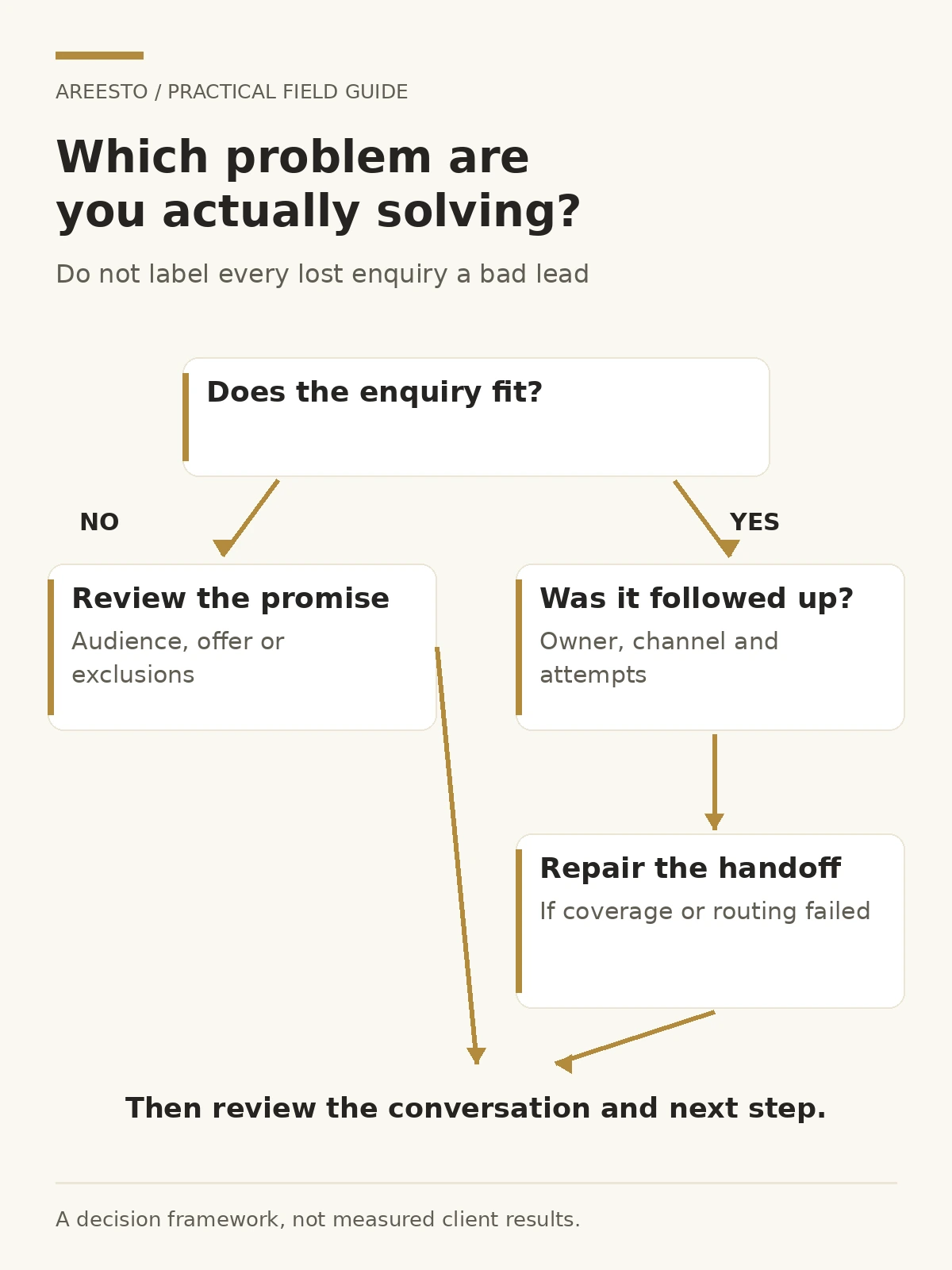
Distinguish poor fit from poor follow-up
Review real enquiries together. What did the person see? What did they ask? When was an owner assigned? What response was sent, through which channel and in which language? A record marked “unreachable” is incomplete unless the team can explain the attempts and the contact details used.
Do not invent a universal response-time target from an unrelated industry. Agree a service level your team can cover, including working hours, leave and reassignment. Then measure whether it happens. A qualified contact left without an owner is a process failure, not proof that the ad attracted the wrong audience.

| Observed issue | Evidence to inspect | Possible next action |
|---|---|---|
| Wrong service requests | Search terms, ad wording, page promise | Clarify offer and exclusions |
| Relevant but unready | Buyer questions and purchase context | Offer useful follow-up rather than immediate rejection |
| No conversation | Owner assignment, attempts, channel preference | Repair routing and follow-up coverage |
| Conversation but no next step | Discovery notes, objections, proposed action | Improve qualification, evidence or sales response |
These are diagnostic possibilities, not automatic explanations. More than one issue can be present. A confusing offer can attract a weak enquiry while a delayed response makes the eventual conversation worse.
Trace the promise from the first click to the CRM
Open the source material beside the sales notes. A campaign inviting a free consultation will attract a different level of readiness from a page asking for a detailed project request. If the sales team expects a purchasing brief from someone who accepted a general introduction, the expectation may be wrong rather than the lead.
Check that the landing page explains who the service is for, what happens after submission and what information is useful. Qualifying questions should help route or prepare the conversation. Each extra field should have a purpose; collecting details that nobody uses creates friction without improving judgement.
As one implementation example, HubSpot’s lifecycle-stage documentation distinguishes a lead, a marketing-qualified lead, a sales-qualified lead and an opportunity. Those are configurable process labels, not universal definitions of customer quality. Agree your meanings before automating them.
Give every enquiry an accountable route
Forms, calls and WhatsApp conversations should not become separate reporting islands. Record the source when known, the customer’s request, assigned owner, stage and agreed next step. If a source is unknown, label it honestly instead of assigning it to whichever campaign was most recently launched.
A click-to-chat event is not proof that a meaningful WhatsApp conversation occurred. A form submission is not proof that sales accepted the enquiry. Keep those stages distinct in reporting. Any sharing of customer information between systems should follow your organisation’s applicable privacy requirements and approved handling practices.
Use rejection reasons that lead to a decision
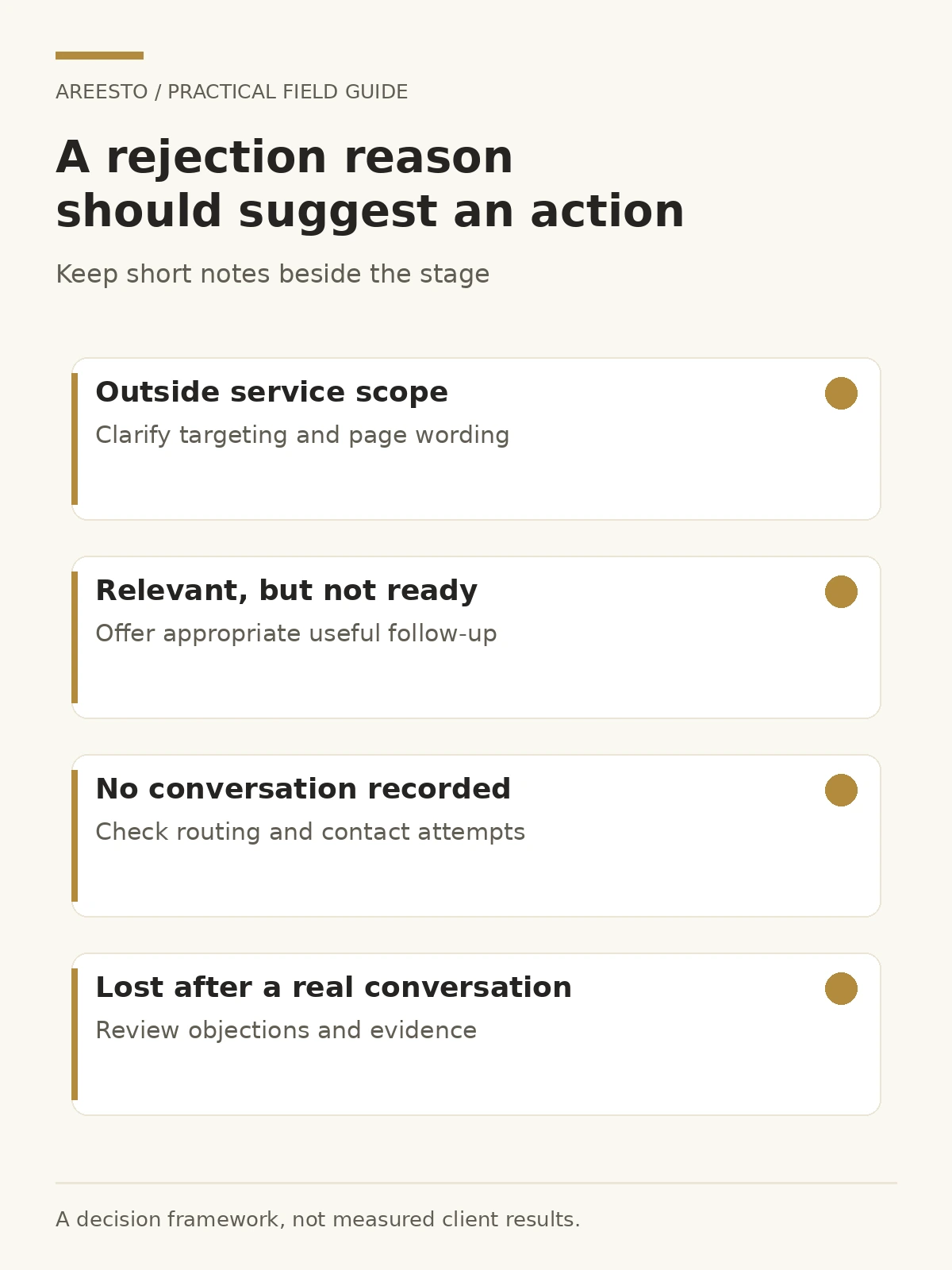
Replace the single “not interested” bucket with a small, workable set of reasons. Useful distinctions might include outside service scope, outside service area, duplicate or spam, not ready, unable to contact after the agreed process, or lost after a relevant conversation. Adapt the categories to your business rather than collecting labels for their own sake.
Keep a short note supporting the reason. “Asked only for printing; campaign was intended for strategy and identity” is actionable. “Not serious” is an opinion unless the conversation establishes what was missing. Preserve room for “unclear” when the evidence is incomplete.
Review recurring patterns by source and offer, not only by salesperson. If an ad repeatedly creates the same misunderstanding, revise the promise. If sources look suitable but records stop at assignment, repair ownership. If qualified prospects consistently question the same capability, improve the evidence and discovery conversation before changing the audience.
Make the next test small enough to interpret
A dramatic campaign rebuild can hide the original cause. When practical, make a focused change tied to the diagnosis: clarify a service exclusion, simplify an irrelevant form field, revise an enquiry confirmation or establish a backup owner. Record what changed and which stage should improve.
Use comparable reporting definitions before and after the change. If sales tightens qualification while marketing changes targeting, an apparent decline in lead quality may be a measurement change. Also account for incomplete follow-up: recent enquiries have not had the same opportunity to become meetings as older ones.
For a simple review, bring a set of accepted enquiries, rejected enquiries and unresolved records to the same discussion. Do not cherry-pick only the most frustrating calls. Examine what the data can establish and what still requires a conversation with the buyer.
A useful weekly question is not “who is responsible for the bad leads?” It is “which recurring failure can we identify, who owns the correction and how will we know it was implemented?” That keeps the review tied to a decision rather than a defensive exchange of dashboards.
For help connecting campaigns to qualification and follow-up, explore Areesto’s lead-generation services in Dubai. Start with the current enquiry journey and a shared definition of a useful opportunity, not a target for form fills alone.
Keep the acquisition system in view while diagnosing quality
B2B lead generation in Dubai means finding and qualifying business buyers who are likely to need what you sell, then passing them to sales with enough context to start a real conversation. It usually combines search, LinkedIn, targeted outreach, events and your website, with clear qualification rules and fast follow-up so leads do not go cold.
This guide explains how it works and what to look for in a partner. For our service, see B2B lead generation in Dubai and the broader lead generation page.
What is a qualified B2B lead?
A qualified B2B lead is a contact at a company that matches your ideal customer profile, has a relevant need, and has shown interest or agreed to talk. Most teams define it with simple criteria such as company type and size, role, need, timeframe and budget range, agreed in writing between marketing and sales.
Which lead generation channels work in Dubai?
| Channel | How it generates leads | Good for |
|---|---|---|
| Google search ads and SEO | Buyers searching for a supplier find your pages | Clear, searched-for services |
| Targeted ads and outreach to roles and companies | Reaching decision makers at named accounts | |
| Outbound email and calls | Personalised contact with a defined list | Niche markets with known buyers |
| Events and exhibitions | Meetings at trade shows and industry events | Relationship-led sectors |
| Website conversion | Forms, calls and WhatsApp from visitors | Turning existing traffic into enquiries |
How does the lead generation process work?
- Define the target: ideal customer profile, target accounts and buying roles.
- Build the offer: a clear reason to talk, such as an audit, consultation or demo.
- Run the channels: search, LinkedIn, outreach or events, depending on the market.
- Qualify: check each lead against the agreed criteria.
- Hand over: pass qualified leads to sales with context, in the CRM.
- Follow up and learn: track outcomes and adjust targeting and messages.
Why does follow-up speed matter?
Business buyers often contact several suppliers at once. An unanswered enquiry leaves the buyer without the information needed to continue the conversation. Agree a response time, route leads automatically to the right person and track how fast your team replies, including on WhatsApp.
What affects the cost of B2B lead generation?
Cost depends on how narrow and competitive your target market is, which channels you use, whether outreach is included, how strict the qualification criteria are and how much content or landing page work is needed. Compare options by cost per qualified lead and pipeline created, not by the number of contacts delivered.
- Size and competitiveness of the target market.
- Channel mix and media spend.
- Depth of research and personalisation.
- Qualification standard and reporting.
What should you ask a lead generation company?
- How do you define and check a qualified lead?
- Which channels will you use for our market, and why?
- Where does the contact data come from, and how do you handle data protection and consent?
- Who owns the campaigns, data and ad accounts?
- What will we see in reporting each month?
Be careful with offers based on bought lists or large volumes of unverified contacts; they can damage your reputation and waste sales time. Make sure outreach respects the UAE’s data protection rules and each platform’s terms.
How do you measure lead generation?
Track leads by source, the share that meet your qualification criteria, meetings held, opportunities created, pipeline value and closed revenue. Review results with sales monthly. A smaller number of well-qualified leads is usually worth more than a large list that sales cannot use.
For the wider plan, read our B2B marketing strategy for the UAE.
How should the hand-over to sales work?
A good hand-over gives the salesperson everything needed to continue the conversation without asking the buyer to repeat themselves. Each lead should arrive in the CRM with the company, role, source, what they asked about and any qualification notes. Agree who picks up which leads, for example by sector, emirate or language, and what happens if a lead is not contacted within the agreed time.
- Routing rules: by sector, territory or language.
- Context: source, request and qualification notes on every record.
- Response target: agreed and tracked, including WhatsApp.
- Feedback loop: sales marks lead quality so targeting improves.
Should you build lead generation in-house or outsource it?
In-house teams know the product best but can be slow to build channel expertise. An outside partner brings experience across channels and tools but needs time to learn your market. Many Dubai companies combine both: an external team runs campaigns and outreach, while an internal salesperson qualifies and follows up. Whatever you choose, keep ownership of the accounts and data.
Common lead generation mistakes in Dubai
- Buying contact lists: purchased lists are often outdated and can create data protection and reputation risks. Build your own audience instead.
- Vague targeting: “decision makers in the UAE” is not a target. Define the industry, company size, location and job titles.
- Weak landing pages: sending ads to a homepage rather than a focused page with one clear offer and a short form.
- No agreed definition of a qualified lead: marketing and sales argue about quality when the criteria were never written down.
- Slow follow-up: enquiries that wait days for a reply often go cold or to a competitor.
A simple 30-day lead generation sprint
The following is an illustrative planning sequence, not a promise of lead volume or results within thirty days:
- Week 1: define the ideal customer profile, write the qualified-lead criteria and choose one offer, such as an audit or consultation.
- Week 2: build a focused landing page, connect the form to your CRM and set up conversion tracking.
- Week 3: launch one or two channels, for example LinkedIn outreach and search ads for high-intent keywords, with a small test budget.
- Week 4: review every lead with sales, note what converted and what did not, and adjust targeting, message and offer.
Strong lead generation also depends on brand trust. Prospects will look you up, so make sure your website and profiles look credible; if they do not, a branding partner can help before you increase spend.
Key takeaways
- Agree what a qualified lead is before you start.
- Match channels to how your buyers search and buy.
- Reply fast and measure pipeline, not contact volume.
Talk to a Dubai B2B marketing team
If you want a second opinion on where your brand stands, book a free consultation or message us on WhatsApp. We will look at what you have today and tell you plainly what to fix first.
Frequently asked questions
What is the difference between a lead and a qualified lead?
A lead is any contact who has shown some interest. A qualified lead also matches your target profile and agreed criteria, such as role, company type, need and timeframe.
Is buying a B2B contact list a good idea?
Usually not as a main strategy. Purchased lists are often outdated, can raise data protection issues and may harm your reputation. Targeted, consent-aware outreach works better.
How quickly can lead generation start producing leads?
Timing depends on channel readiness, market fit and the buying cycle. Review implementation and conversation evidence rather than promising a fixed lead-delivery date; judge commercial outcomes over the relevant sales cycle.
Should lead generation be paid per lead?
Pay-per-lead can work if qualification is strict and agreed in writing. Otherwise it can reward volume over quality. Many companies prefer a managed fee with clear targets.
Which CRM should we use?
Use one your team will actually update. What matters most is that every lead from every channel lands in the same place with its source recorded.
Is cold email allowed in the UAE?
Rules on electronic marketing and personal data apply, and they change over time. Get current legal advice, use relevant and respectful messages, and always offer an easy way to opt out.
What is a good first offer for B2B lead generation?
Something useful and low-risk for the buyer, such as an audit, assessment or short consultation. It should relate directly to the service you want to sell.
How many leads should we expect from a campaign?
There is no reliable universal number; it depends on your market size, offer, budget and sales cycle. Run a small test, measure cost per qualified lead and conversion to meetings, then set targets from your own data.
Should leads go straight to sales?
Only when they meet your agreed qualification criteria. Others should enter a nurture sequence with useful content until they show stronger buying signals.