
Beyond the Skyline: How Dubai Hotels Turn Lookers into Bookers
Every Dubai hotel has a view. That is exactly the problem. When a traveller scrolls through a dozen properties that all promise skyline sunsets, infinity pools and “unforgettable experiences”, the skyline stops being a reason to book and becomes background noise.
The short answer: Dubai hotels turn lookers into bookers by replacing generic glamour with a specific reason to choose them, then removing every bit of friction between that first glance and a confirmed reservation. Attention is cheap in this market. Conversion is earned in the details: the photos, the room descriptions, the mobile booking flow and how quickly a real person answers a question.
Why “lookers” don’t book
A looker is someone who has noticed you but has not yet decided. They might be comparing you on an online travel agency, saving your Instagram post, or reading your website on a phone between meetings. Most of them leave without booking, and they rarely tell you why.
The reasons tend to fall into a few familiar patterns:
- No clear difference. The property looks beautiful, but so do the five others in the same tab. Nothing tells the guest who this hotel is for.
- Missing answers. Is the pool shaded in the afternoon? How far is the metro, the beach or the business district? Is breakfast included? If the answer takes more than a few seconds to find, the guest goes back to the comparison site.
- Friction on mobile. Slow pages, pop-ups, a booking engine that resets dates, or a final price that looks different from the first one.
- No human signal. No quick way to ask a question on WhatsApp, chat or phone, and no sign that anyone is listening.
Start with a sharper promise
Before touching ads or the website, decide what your property genuinely does better than the hotel next door. Not “luxury” or “world-class”, but something a guest can picture.
That might be the quietest rooms near a major business district, the easiest base for families visiting the big attractions, a rooftop that locals actually use, or a design hotel that feels like a gallery. Our guide to brand positioning for hotels in Dubai goes deeper into finding that promise. Here, the point is practical: once you know your promise, every photo, headline and offer can prove it.
Turn the promise into proof
A promise only works when the guest can see evidence of it. If you say “family-friendly”, show the connecting rooms, the kids’ menu and the shallow pool, not just a smiling family stock shot. If you say “work-ready”, show the desk, the sockets and the lobby corner where people take calls.
Fix the “look” stage: photos and first impressions
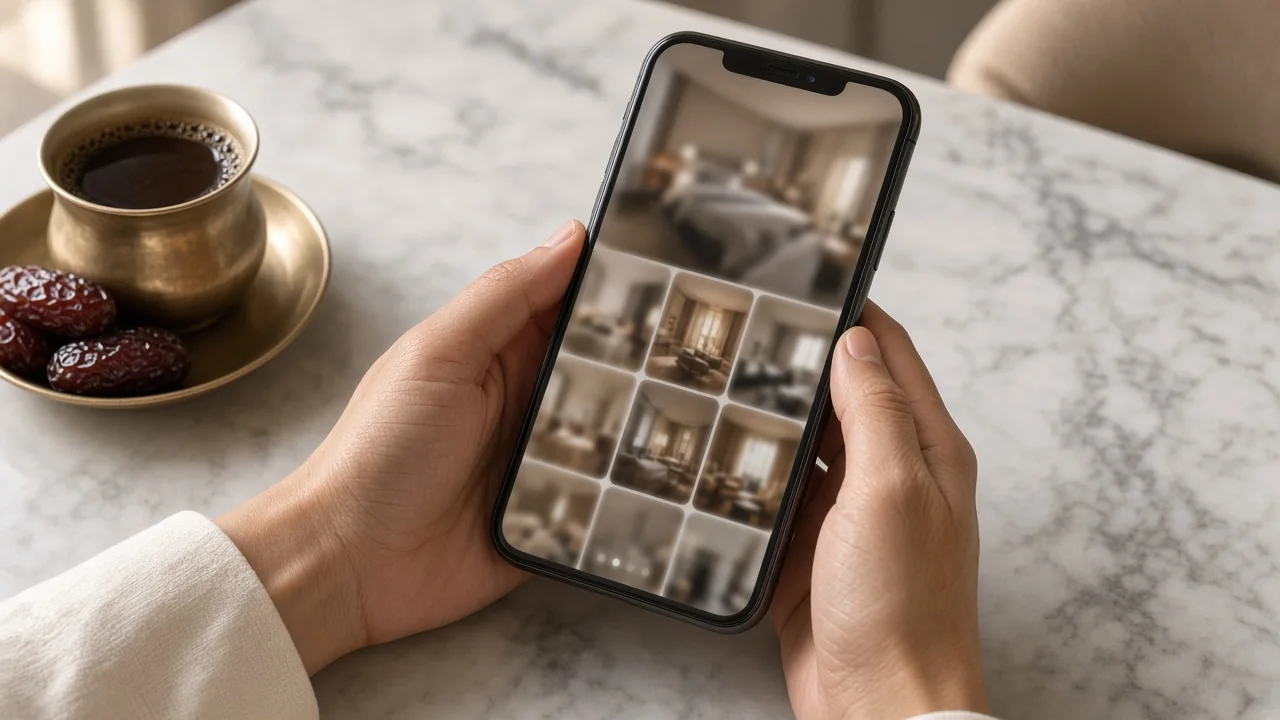
Most first impressions now happen on a phone screen, often inside a gallery that the guest swipes through in seconds. Treat your photo set as a sales sequence rather than an archive.
- Lead with the room people will actually book, not only the presidential suite.
- Show scale and light honestly. Wide-angle shots that make a room look twice its size create disappointment at check-in, and disappointment becomes reviews.
- Include the in-between moments: the walk from the lobby to the lift, the breakfast spread, the view from a standard room at night.
- Keep galleries consistent across channels. Guests often see your property on an OTA first, then check your website and social media. If the pictures look like three different hotels, trust drops.
Fix the “think” stage: answer questions before they’re asked
Between noticing and booking, guests run through a mental checklist. Your job is to answer it in plain language on the room and offer pages.
Write room descriptions people can use
Replace adjectives with facts. Instead of “a stunning sanctuary of comfort”, say what the bed size is, how many people the room sleeps, whether the bathroom has a bathtub, and which direction the window faces. A short “good to know” block under each room type, covering check-in times, parking, pets, transport and nearby landmarks, answers the questions that otherwise turn into abandoned sessions or emails nobody replies to.
Make price clarity a selling point
Unexpected fees are one of the fastest ways to lose a booking at the final step. Show what is included, explain any city or service charges clearly, and keep the price consistent between your ad, your landing page and the booking engine.
Fix the “book” stage: the mobile path
Run a simple test every month: try to book your own hotel on a mid-range phone, on mobile data, as a first-time guest. Time it. Note every moment you hesitate.
Common fixes include:
- Reducing the number of steps and form fields in the booking engine.
- Remembering dates and guest numbers as the user moves between pages.
- Offering familiar payment options and showing security cues near the payment field.
- Making the cancellation policy visible before the guest enters card details, not after.
A beautiful website that loses guests at the payment step is an expensive brochure. Our web design, SEO and AEO service for hotels in Dubai focuses on exactly this path.
Add a human shortcut
In the UAE, many guests prefer to ask before they book, especially families, groups and long-stay travellers. A visible WhatsApp or chat option, staffed by someone who can quote, hold a room or answer a question about airport transfers, can rescue bookings that a form never would.
Set response standards your team can actually meet, and track the conversations that become reservations. That data tells you which questions your website should answer next.
Measure what moves guests, not just what gets likes
Likes, reach and follower counts show attention. They do not show bookings. To know whether lookers are becoming bookers, connect your channels to outcomes:
- Track where booking sessions start and where they drop off.
- Tag campaign links so you can separate brand awareness traffic from ready-to-book traffic.
- Review enquiry logs weekly to spot recurring questions and objections.
- Compare direct conversion with OTA performance for the same room types and dates.
Small, regular improvements to the weakest step usually beat a big redesign every few years.
A simple 30-day plan
- Week 1: Write down your one-sentence promise and check whether your homepage, top room page and main OTA listing actually say it.
- Week 2: Audit your photo galleries for honesty, order and consistency across channels.
- Week 3: Rewrite your three most-booked room descriptions with facts, a “good to know” block and clear pricing.
- Week 4: Test the mobile booking path, fix the two worst friction points and add a visible human contact option.
If you would like an outside view of where your hotel loses guests, our hospitality and hotel marketing team in Dubai can audit the journey from first glance to confirmed booking. You may also want to read how to cut OTA dependence with more direct bookings and how to get your hotel recommended by AI assistants.
Frequently asked questions
What is the biggest reason Dubai hotel website visitors don’t book?
There is rarely a single reason, but the most common are a lack of clear difference from competing hotels, missing practical information, and friction in the mobile booking flow. Testing your own booking path on a phone is the fastest way to find out which applies to you.
Should a hotel focus on more traffic or better conversion first?
Usually conversion. If your website and booking engine lose interested guests, more traffic just means paying to lose more of them. Fix the path first, then scale campaigns.
How many photos should a hotel room page have?
Enough to answer the guest’s questions honestly: the bed, the bathroom, the view, the workspace and the room in natural light. Quality and order matter more than quantity.
Does WhatsApp really help hotel bookings in the UAE?
For many properties, yes, because guests in the region are used to messaging businesses directly. It works best when someone can respond quickly with a quote or a clear answer, and when those conversations are tracked.