
Beyond Clicks and Leads: What a Useful UAE Marketing Report Should Show

Imagine a monthly review where every chart points upward, yet nobody can explain which enquiries became useful conversations. The report contains plenty of activity and very little basis for the next decision.
A useful marketing report connects activity, response, qualification and commercial outcomes, states what the data cannot establish and ends with decisions owned by named roles. Clicks and leads belong in the report, but they are not interchangeable with customers or profit.
Marketing reporting should help leaders understand how spending and activity relate to business objectives. That does not mean every campaign can be assigned a precise positive return. A credible report makes the measurement basis and uncertainty visible rather than using confident charts to hide them.
This guide helps UAE business leaders move beyond isolated visibility metrics while retaining useful diagnostic information. It develops the original ROI, accountability and brand-building discussion into a practical reporting structure for marketing and sales.
1. The Flaw of Focusing on Vanity Metrics
Followers, views and clicks can describe distribution and response, but they do not by themselves prove financial value. Keep them when they help answer a defined question. Avoid labelling every awareness measure useless simply because it is not a sale; the error is presenting it as a commercial outcome without supporting evidence.
Ask which new enquiries were relevant, which received a real conversation and which progressed to a commercial decision. Then ask what evidence connects those records to marketing. The goal is not to prove a predetermined positive return; it is to understand performance well enough to choose an appropriate action.
2. Connecting Marketing to Revenue: A Data-Driven Approach
Connect relevant marketing records with CRM and financial information where appropriate and permitted. Shared identifiers, consistent campaign naming and clear stage definitions can improve the connection. Not every journey will be observable, and integration alone does not establish that marketing caused every recorded sale.
Key metrics to focus on include:
Customer acquisition cost: acquisition costs divided by the new customers counted on a clearly defined basis. State the period, included costs and customer definition; do not silently compare media-only spend with a fully loaded measure.
Customer lifetime value: a forward-looking estimate whose meaning depends on the revenue, contribution, retention and cost assumptions used. State those assumptions and avoid presenting an immature cohort as an observed lifetime result.
Marketing-originated revenue: revenue associated with a defined marketing-origin classification. Explain the classification and distinguish it from marketing-influenced revenue so the same sale is not counted twice in a combined total.
Return on ad spend: attributed advertising revenue relative to advertising spend. It is not automatically profit or total marketing ROI, and its interpretation depends on the attribution and revenue definitions.
Use these measures only when the necessary inputs are reliable. A profit-based ROI calculation needs an agreed treatment of incremental contribution and marketing investment, not simply a revenue total beside an ad bill. Where incrementality cannot be established, label the result as an attributed or indicative measure rather than a proven causal return.
3. Building a Culture of Marketing Accountability
Accountability means agreeing the outcome and the evidence the team can reasonably influence. Rewarding only the number of posts can distort priorities; rewarding only closed sales can also obscure long buying cycles and shared responsibilities. Use a balanced stage-based review with explicit limits.
Establish clear goals: connect the reporting question to the business objective, then define the observable stages and evidence required. Do not invent an industry benchmark to make the target sound rigorous.
Regular reporting: choose a review cadence appropriate to the buying cycle and decision. Show trends, record-quality limitations and actions rather than producing a new presentation without resolving earlier questions.
Cross-departmental collaboration: marketing and sales should agree stage meanings, handoff responsibilities and feedback on relevance. Finance should help define commercial measures. A missing response record is not automatically a bad lead, and a sale is not automatically attributable to the last visible click.
4. The Brand as a Financial Asset
Beyond immediate campaign response, brand-building can affect recognition, understanding and preference. These are useful strategic questions, but a brand should not be described as a tangible asset or assigned a financial uplift without an appropriate valuation basis. Keep accounting treatment and formal valuation separate from a campaign dashboard.
Marketing and branding may support long-term business objectives, while the evidence can emerge at different times and through different measures. State which question a brand measure answers and what it does not prove about current-period revenue.
Define the funnel before judging the totals
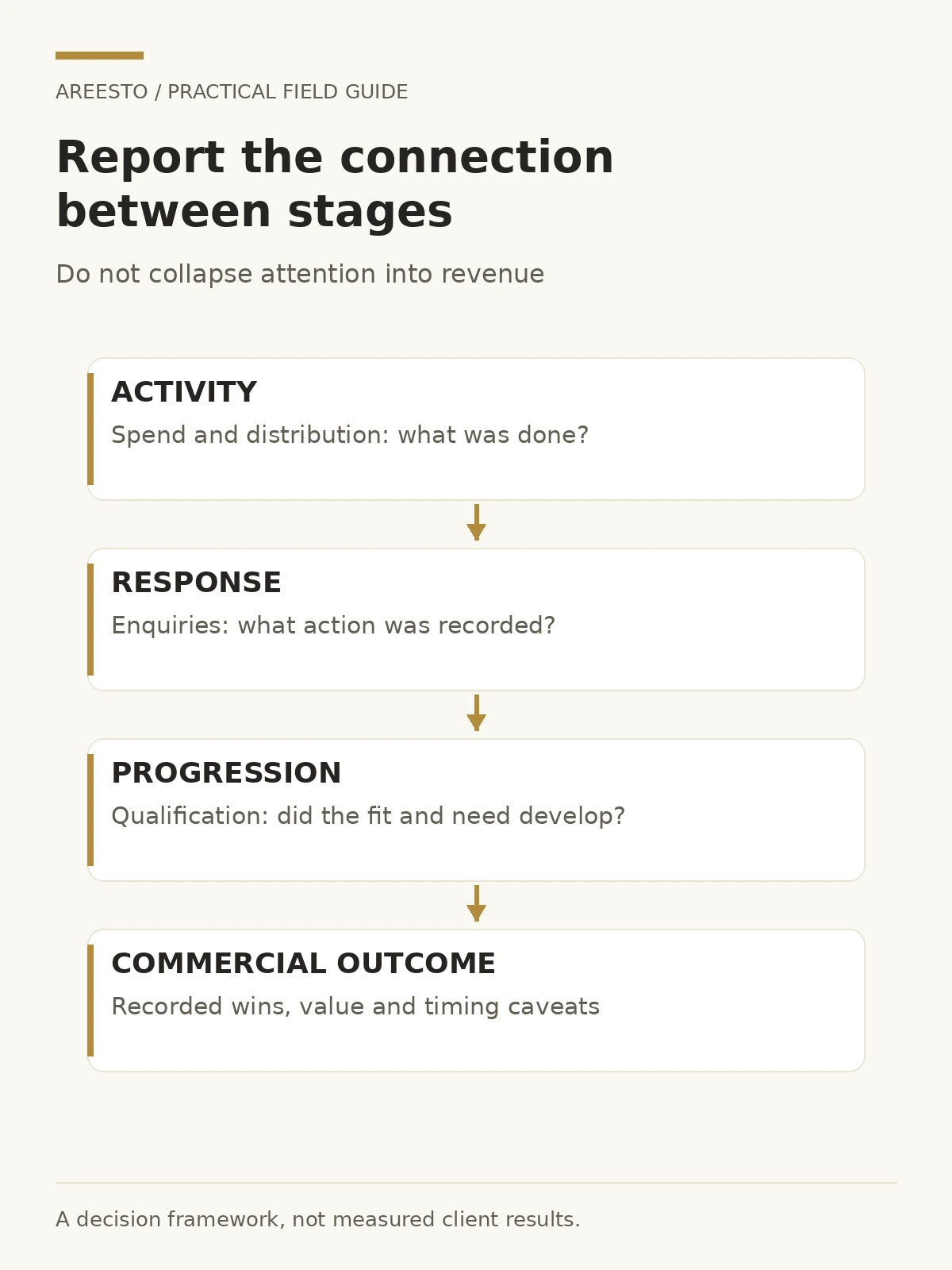
Write down the entry condition for each stage. An enquiry is a recorded response; a qualified opportunity needs whatever evidence your organisation requires about fit, need and a real next step. Keep rejected, duplicate and incomplete records visible enough to explain the totals without exposing unnecessary personal information.
Separate lead creation from progression. A report on enquiries created this month is not the same as a report on deals closed this month. If the sales cycle spans reporting periods, show cohort or stage timing so a reader does not interpret unfinished opportunities as confirmed failures or count old wins as new campaign results.
| Layer | Evidence to review | Decision it informs |
|---|---|---|
| Activity | Spend, distribution and execution | Was the plan delivered? |
| Response | Enquiries and contact routes | Did the intended action occur? |
| Qualification | Fit, conversations and next steps | Is the offer reaching relevant buyers? |
| Outcome | Recorded commercial progression | What should change, with what caveats? |
For each line, show the data source, period and definition. If the same metric changes definition, disclose the break rather than drawing an uninterrupted trend. A clean-looking comparison can mislead when its underlying meaning changed.
Explain attribution gaps instead of hiding them

Attribution assigns credit across observed interactions. Google’s Analytics attribution documentation describes model-based credit allocation; a model is not a complete record of every influence on a buying decision. Offline discussions, incomplete records and other unobserved activity can leave gaps.
Write a limitations box. It might identify missing source fields, unresolved duplicate records or an outcome still awaiting confirmation. Do not invent values to fill it, and do not interpret “unknown” as proof that no marketing influence existed. Equally, do not assign every unknown sale to marketing because that would improve the dashboard.
Agree how different systems are reconciled. Platform-reported revenue, CRM opportunities and financial sales records may use different dates and definitions. Explain the basis before combining totals. Keep an attribution-model or tracking change in the reporting notes so it is not mistaken for a sudden improvement in customer behaviour.
End the review with a decision log
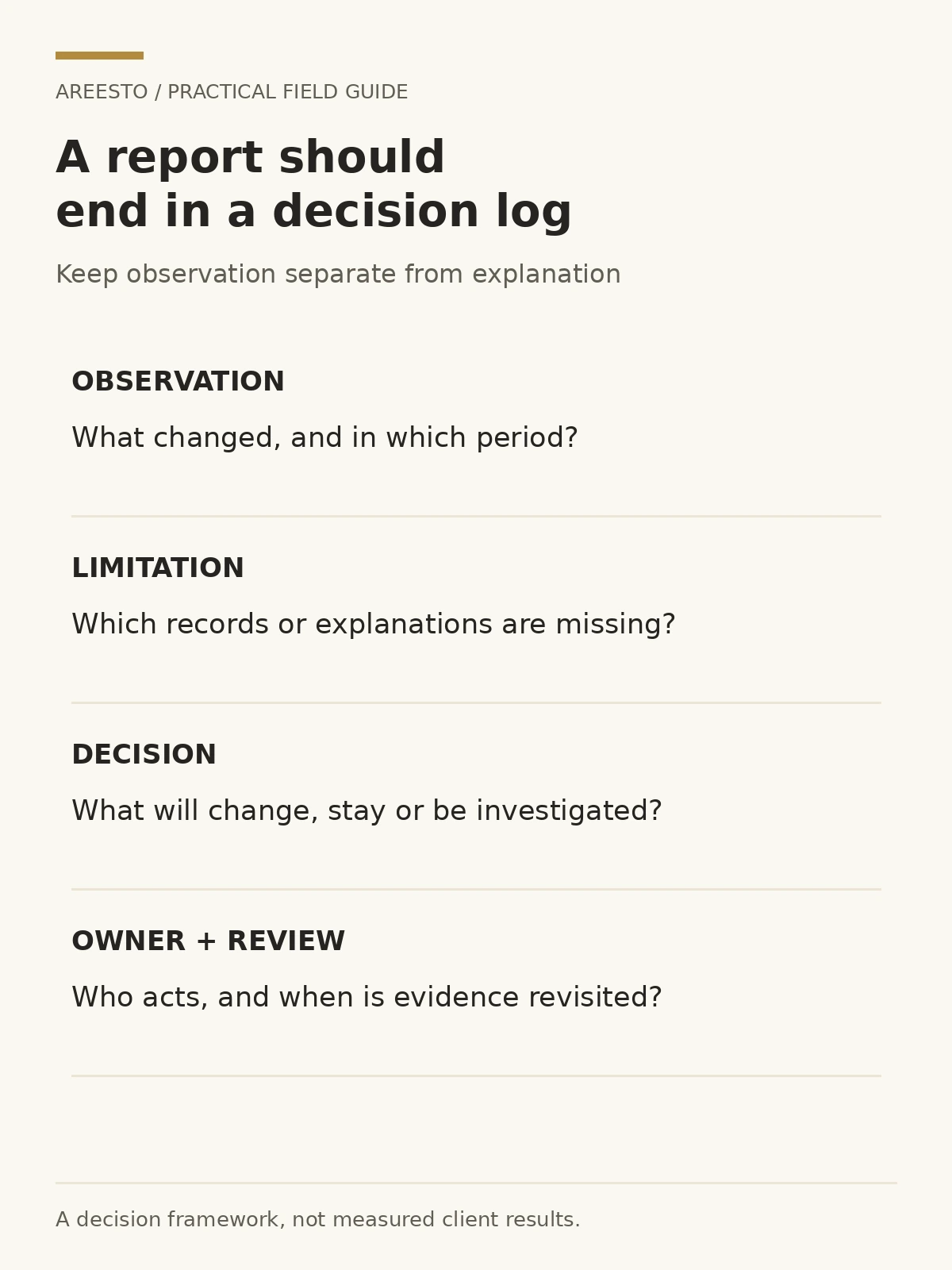
Separate observation from explanation: what changed, what might explain it and what evidence could distinguish those explanations? If enquiries fell while a contact form was broken, fix the journey before concluding that buyers rejected the message.
For each decision, record the action, accountable role, evidence sought and review trigger. A decision may be to change an offer, repair tracking, improve response coverage or leave a campaign unchanged while outcomes mature. “Optimise performance” is not a sufficiently specific action.
Revisit the previous log at the next review. Was the action completed, did the anticipated evidence arrive and does the explanation still hold? This turns reporting into a learning process rather than an escalating demand for more slides.
A useful report does not need every metric a platform can export. It needs a clear business question, dependable definitions, honest limitations and an action the team can revisit. Discuss B2B marketing and reporting in Dubai with a brief that includes the decisions your team needs to make, not only the charts it wants to see.
Frequently asked questions
Are clicks and impressions vanity metrics?
They can be useful diagnostic measures. The problem is treating them as proof of sales or profit without evidence connecting the stages.
Is ROAS the same as marketing ROI?
No. ROAS relates attributed ad revenue to ad spend. A profit-based ROI measure needs a defined contribution and investment basis, with attribution and incrementality limits made clear.
Why do platform and CRM totals disagree?
They may use different definitions, dates, models or observed records. Reconcile the basis before combining or comparing the figures.
What should the monthly review produce?
A clear reading of performance and limitations, plus specific decisions with accountable owners and a review trigger.