
Sensory Storytelling: How to Build Lasting Loyalty in Dubai’s Hyper-Competitive Marketplace

Sensory Storytelling: How to Build Lasting Loyalty in Dubai’s Hyper-Competitive Marketplace
In Dubai’s commercial landscape, competition is no longer fought merely on the battlegrounds of product functionality or pricing. Driven by the ambitious D33 Economic Agenda and an influx of global brands, the city has transformed into one of the most saturated marketplaces in the world. For business leaders, this saturation presents a critical challenge: skyrocketing digital Customer Acquisition Costs (CAC) and a rapidly declining return on transactional marketing.
When every brand claims to be “luxury,” “premium,” or “innovative,” consumer satisfaction and traditional loyalty models begin to weaken (Xi et al., 2022). To survive, contemporary brands are forced to move beyond utilitarian marketing models. Instead, they must treat consumers not just as buyers, but as “aesthetic subjects” who seek sensory, emotional, and symbolic dialogues with the marketplace (Kumar, 2025).
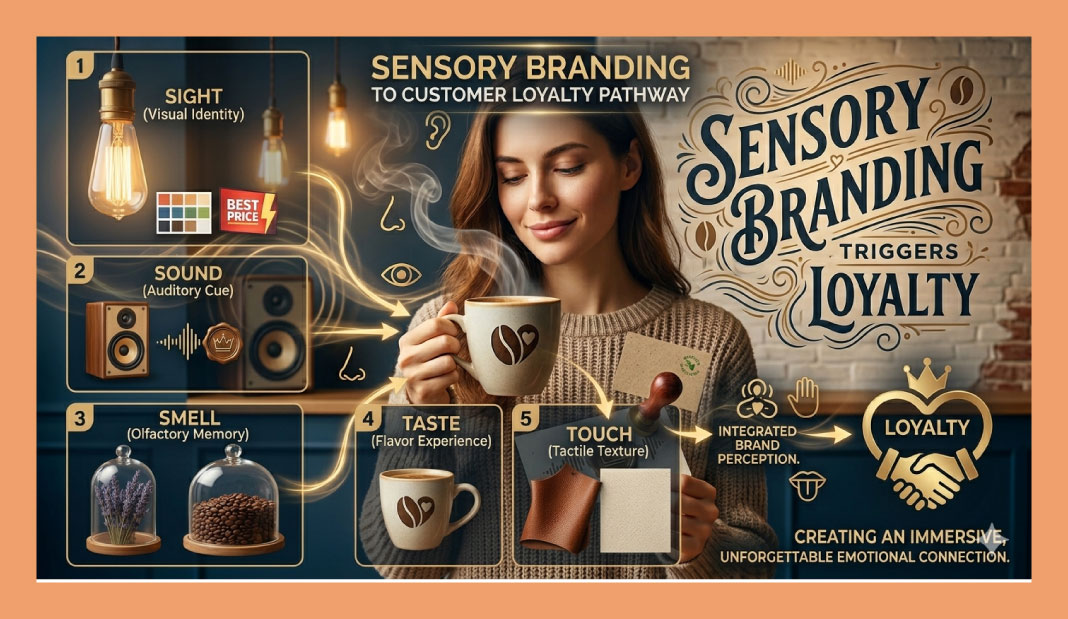
Building lasting brand loyalty in Dubai requires a deliberate shift from functional transactions to experience-based, immersive consumption (Sifa, 2026). This is the discipline of Sensory Storytelling—the deliberate architecture of multisensory brand environments designed to bypass rational skepticism, trigger deep emotional attachments, and cultivate unshakeable customer commitment.
The Science of the Senses: Why Sensory Branding Triggers Loyalty
For years, relationship marketing relied heavily on the belief that customer satisfaction automatically breeds brand loyalty. However, global consumer psychology studies demonstrate that transactional satisfaction alone is no longer sufficient to guarantee long-lasting, profitable customer relationships, especially in premium sectors (Xi et al., 2022). True brand experience is a subjective consumer response encompassing sensations, feelings, and cognitions triggered by brand-related stimuli (Zha et al., 2025, as cited in Indrasari, 2026).
 Recent empirical research published in Psychology & Marketing highlights the mechanics behind this shift. In a comprehensive multi-study analysis of retail environments, researchers found that physical encounters intimately tied to an individual’s five senses give physical brand spaces a massive advantage over digital commerce (Shahid et al., 2022). Engaging multiple senses directly enhances the consumer’s holistic brand experience, which functions as a direct driver of deep emotional attachment and subsequent brand loyalty (Shahid et al., 2022).
[Sensory Marketing Cues]
│
▼
[Enhanced Brand Experience] ──► [Emotional Attachment] ──► [Unshakeable Brand Loyalty]
When a brand successfully coordinates visual, auditory, olfactory, tactile, and gustatory (taste) cues, it establishes an emotional bond that operates on a subconscious level rather than a purely rational one (Biswas, as cited in Shang et al., 2023). In Dubai’s ultra-luxury and premium spaces—from the flagship boutiques of Dubai Mall to the experiential dining concepts in Downtown—this multisensory dimension is not just a decorative supplement; it is an integral strategic asset (Shahid et al., 2022).
Decoding the Five Dimensions of Sensory Storytelling in Your Brand Strategy
To implement a successful sensory storytelling framework, an agency or brand must purposefully design an aesthetic unity that answers consumers’ sensory and self-expressive needs (Kumar, 2025). This requires breaking down the experiential journey into five distinct, yet highly coherent, sensory channels.
1. Visual Architecture and Semiotics
Sight is the most immediate sensory trigger, but in a city filled with architectural marvels, visual noise is a constant challenge. Effective visual storytelling relies on visual semiotics—using color, texture, geometry, and symbolism to convey meaning through cultural codes (Kumar, 2025). Rather than trying to be the loudest visual entity in a Dubai district, premium brands must maintain an absolute alignment between their visual identity and consumer values. The visual environment must signal exclusive status and aesthetic harmony, transforming a retail space or corporate office into a tangible manifestation of the consumer’s desired self-concept (Xi et al., 2022).
2. The Olfactory Identity (Signature Scenting)
Smell has the unique neurological ability to bypass the brain’s logical filtering centers and travel directly to the limbic system, the seat of emotion and memory. In Dubai, ambient scenting is already widely utilized, yet many brands make the mistake of using generic, overpowering fragrances. True sensory storytelling demands a bespoke olfactory signature that matches the brand’s core narrative. A luxury real estate presentation center, for instance, might deploy subtle notes of cedarwood and amber to evoke feelings of structural permanence, heritage, and elite comfort, permanently anchoring that specific emotional state to the developer’s identity.
3. Soundscapes and Auditory Brand Strategy
Auditory cues dictate the pacing and energy of a consumer experience. Recent studies note that external, distal sensory cues like sound significantly shape consumer perception, motivation, and learning (Bai, 2026). In the context of Dubai’s retail and hospitality industries, generic background music destroys brand authenticity. Curated auditory branding—ranging from bespoke acoustic soundscapes in high-end wellness clinics to the precise, engineered sound of a luxury appliance door closing—communicates complexity and high-level quality without requiring a single word of copy.
 4. Tactile Textures and Haptic Engagement
Touch is the ultimate validator of quality. Consumers naturally equate physical weight, material texture, and surface resistance with premium craftsmanship. Research into high-value sectors, such as the luxury watchmaking industry, confirms that sensory marketing cues and tactile brand experiences interact directly to foster deep customer commitment (Chandra & Balqiah, 2023). When a customer holds a heavy, textured catalog, sits on premium full-grain leather inside a Dubai Marina financial lounge, or interacts with a finely engineered matte interface, their tactile sensation actively reduces their perception of financial risk, justifying a premium price point.
5. Gustatory Appeal (The Taste Signature)
While taste is naturally the domain of Dubai’s booming F&B sector, non-food brands are increasingly using gustatory storytelling to finalize the loyalty loop. Serving a bespoke, locally roasted specialty coffee blend or an infused botanical beverage during a real estate closing or a private fashion viewing transforms a standard administrative transaction into an immersive hospitality ritual.
Strategic Implementation: Integrating Sensory Coherence
Deploying sensory marketing haphazardly can backfire. If a retail boutique features aggressive, high-tempo lighting but plays slow, classical music while diffusing a tropical scent, the consumer experiences cognitive dissonance. This sensory mismatch shatters brand trust and drives immediate bounce rates.
To execute sensory storytelling flawlessly within the UAE marketplace, brands should adopt a structured integration methodology:
| Step | Phase | Core Objective | Key Action |
| 1 | Sensory Audit | Identify current sensory outputs. | Map out all existing visual, auditory, tactile, and olfactory touchpoints across physical and digital environments to identify inconsistencies. |
| 2 | Narrative Alignment | Bridge brand values with sensory cues. | Define the core emotional response the brand wants to evoke (e.g., security, euphoria, prestige) and match it to specific scientific sensory markers. |
| 3 | Environmental Design | Architecture of the space. | Build physical environments where store atmosphere serves as a multisensory dimension that enhances human engagement and comfort (Sifa, 2026). |
| 4 | Linguistic Reinforcement | Compensate for digital gaps. | Train teams and program digital interfaces to use precise “sensory language” to evoke vivid mental imagery, enhancing perceived authenticity online (Bai, 2026). |
The Ultimate Payoff: Emotional Attachment to Brand Lovemarks
In a marketplace as dynamic as Dubai, functional superiority is easily replicated. A competitor can always launch a faster platform, build a larger retail layout, or offer a temporary discount. However, a competitor cannot easily replicate a deeply rooted psychological and emotional bond.
By intentionally engineering a coherent, multisensory brand experience, companies transition their customer relationships away from transactional reliance. When sensory satisfaction and emotional resonance align seamlessly with consumer values, it drives a powerful psychological connection known as consumer-brand identity (Xi et al., 2022).
It is within this space that customer satisfaction transforms into a genuine emotional attachment (Shahid et al., 2022). Customers stop comparing features and prices; instead, they become entirely committed to the brand universe. For Dubai businesses aiming to dominate the next decade of regional commerce, sensory storytelling is the definitive bridge to achieving unshakeable customer loyalty and securing a permanent market advantage.
References
- Amelia, T., & Tambunan, J. (2024). The impact of visual aesthetics and consumer perceptions on luxury purchasing decisions. Journal of Consumer Aesthetics, 8(2), 112–126.
- Bai, S. (2026). Can consumers still form proximal sensory perception in virtual anchor live streaming? The impact of the fit between sensory language description and product attributes. Journal of Theoretical and Applied Electronic Commerce Research, 21(3), 92–110. https://doi.org/10.3389/jtaer.2026.0012
- Cited by: 1
- Chandra, A. T., & Balqiah, T. E. (2023). Utilizing sensory marketing and brand experience: The case of luxury watchmaking. Asia Pacific Management and Business Application, 12(1), 19–38. https://doi.org/10.21776/ub.apmba.2023.012.01.2
- Cited by: 4
- Indrasari, R. (2026). Brand experience, brand image, and customer satisfaction strategies in increasing customer loyalty (Adidas brand case study). Journal of Motivation Management, 14(1), 45–58.
- Cited by: 1
- Kumar, S. (2025). Aesthetic of consumption: A review of sensory branding and visual semiotics in consumer experience. Aesthetic and Consumer Research Journal, 17(4), 1787–1802.
- Cited by: 2
- Septiano, R., Hussain, M., & Japutra, A. (2024). The mediating role of customer satisfaction in premium retail spaces. International Journal of Retail Management, 32(3), 201–218.
- Shang, E., Vignali, G., & Henninger, C. (2023). The influence of sensory marketing on consumers with different characteristics regarding physical store shopping. Springer Texts in Business and Economics, 209–240. https://doi.org/10.1007/978-3-031-33302-6_12
- Cited by: 1
- Sifa, F. A. (2026). Sustainability and experiential marketing synergy: The mediating role of customer satisfaction in building customer loyalty. Greenation International Journal of Economics and Accounting, 3(4), 773–789.
- Cited by: 0
- Xi, X., Yang, J., Jiao, K., Wang, S., & Lu, T. (2022). “We buy what we wanna be”: Understanding the effect of brand identity driven by consumer perceived value in the luxury sector. Frontiers in Psychology, 13, Article 1002275. https://doi.org/10.3389/fpsyg.2022.1002275
- Cited by: 104
Related service: Branding services in Dubai